Frequently Asked Questions
Find answers to the most common questions about IBC totes, our recycling process, pricing, logistics, regulations, and more. Can't find what you're looking for? Contact us directly.
Still Have Questions?
Our team is ready to help. Send us a message and we'll respond within 24 hours.
Get Your Free Quote
Fill out the form and our team will get back to you within 24 hours with a customized solution.
0 of 8 required fields completed
What to Expect
Submit your request details
Receive a quote within 24 hours
Schedule pickup or delivery
Why Choose Us
Prefer to talk? Call us directly:
(313) 555-1234Common Questions & Answers
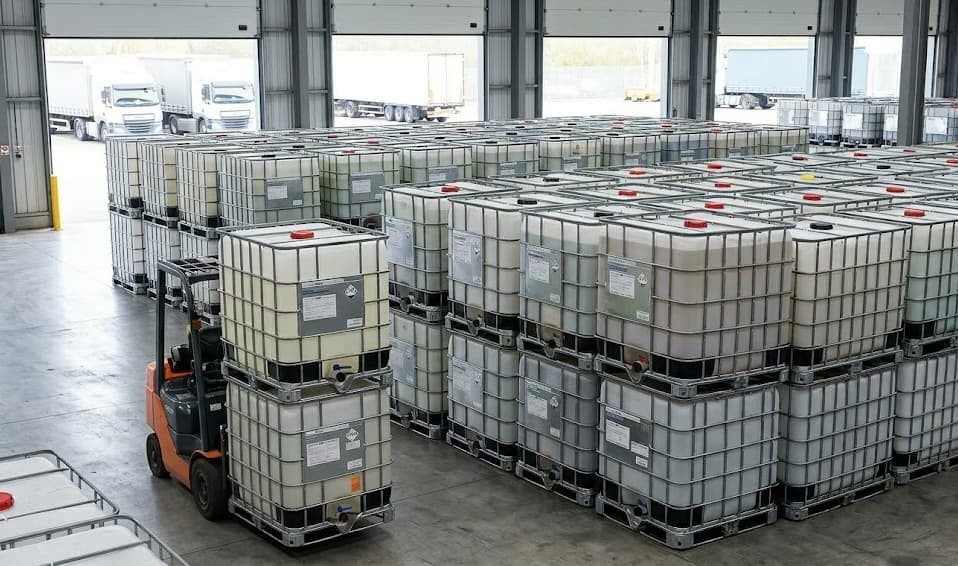
An IBC (Intermediate Bulk Container) tote is a reusable industrial container designed for the storage and transport of bulk liquids and granulated substances. The most common type is a composite IBC, which consists of an HDPE (High-Density Polyethylene) plastic inner bottle held within a galvanized steel cage frame, mounted on a pallet base. Standard IBC totes hold 275 gallons (1,041 liters) and feature a 6-inch fill opening on top and a 2-inch discharge valve on the bottom. They are used across industries including food and beverage, chemicals, pharmaceuticals, agriculture, and manufacturing. The composite IBC design (classified as UN 31HA1) was developed in the 1990s as a safer, more efficient alternative to 55-gallon drums, allowing companies to move nearly five times more liquid in a single container with reduced labor and handling costs.
We stock and recycle all common IBC tote sizes: 275 gallon (the industry standard and our most common size, with a 48" x 40" footprint), 330 gallon (oversized for high-volume needs, same footprint as 275 but 7 inches taller), 180 gallon (compact option with a 36" x 36" square footprint for tighter spaces), and 110 gallon (mini IBC with a 36" x 30" footprint for small batch applications). All sizes are available in various grades and configurations. The 275-gallon is by far the most widely available, both new and used, and has the broadest range of valve options, certifications, and accessories. Visit our Sizing Guide for detailed specifications on each size, including dimensions, weights, valve types, pallet options, forklift pocket dimensions, and stacking heights.
A composite IBC tote consists of several key components: The inner bottle (also called the bladder or liner) is the blow-molded HDPE container that holds the liquid, typically weighing 55-65 lbs for a 275-gallon size. The cage (or outer frame) is the welded tubular steel structure that protects the bottle and provides structural support for stacking and lifting. The pallet base is the bottom platform (HDPE plastic, wood, or steel) that allows forklift and pallet jack handling. The fill port is the 6-inch threaded opening on top with a screw cap and gasket. The discharge valve is the 2-inch cam lock, butterfly, or ball valve at the bottom for dispensing. The drain port adapter connects the bottle outlet to the valve body. The label plate is the metal plate on the cage that carries the UN marking, manufacture date, and serial number. Finally, gaskets are the rubber seals at the cap, valve, and drain port connection points that prevent leaks.
The lifespan of an IBC tote depends on the component and how it is used. The HDPE inner bottle typically lasts 5-7 fill cycles when properly maintained, or approximately 5-10 years of service for multi-trip totes. UV exposure is the primary degradation factor — a natural/white bottle stored outdoors without protection will degrade much faster (2-3 years) than one stored indoors (10+ years). The steel cage lasts significantly longer — 10-15 years or more — because galvanized steel is extremely durable. When the bottle reaches end of life but the cage is still sound, the tote can be rebottled with a new HDPE insert, extending the cage life further. The pallet base lasts 5-15 years depending on material (steel outlasts plastic, which outlasts wood). For UN-rated hazmat IBCs, the regulatory service life is 5 years from manufacture, regardless of physical condition.
The key differences are capacity, efficiency, and handling. A standard 55-gallon drum holds 55 gallons and weighs about 485 lbs when full with water. A 275-gallon IBC tote holds 5x more liquid (275 gallons) and weighs about 2,450 lbs full, but occupies the same pallet footprint as four drums. This means you need one IBC instead of five drums, which dramatically reduces handling time, labor costs, and the number of connections needed during dispensing. IBCs feature integrated pallets for easy forklift handling, while drums require separate pallets or drum handling equipment. IBCs also have built-in discharge valves for direct dispensing, whereas drums typically require pumps or tilting stands. The cost per gallon of storage is generally lower with IBCs. However, drums remain useful for smaller quantities, very aggressive chemicals that require thicker walls, and applications where 55 gallons is the appropriate batch size.
Our recycling process involves several stages: First, we collect or receive used IBC totes at our Detroit facility. Each tote is inspected and graded (A, B, or C) based on its condition. Grade A and B totes are thoroughly cleaned using our multi-step process — residual contents are drained and properly disposed of, the bottle is triple-rinsed with hot water (180F) and biodegradable cleaning agents, sanitizing rinse is applied for food-grade totes, and the interior is inspected with a borescope camera. Valves are disassembled, cleaned, and fitted with new gaskets. The cage is pressure-washed and inspected for structural integrity. These cleaned totes are then resold for reuse. Grade C totes and those beyond reuse are disassembled — the HDPE bottle is shredded into flakes, washed, and sold to plastics recyclers who pelletize it for new products. The steel cage goes to metal recyclers, and wooden pallets are either refurbished or chipped for mulch. Our goal is zero landfill waste, and we maintain a 98% material recovery rate.
Even when an IBC tote is too damaged or contaminated for reuse, we ensure it never goes to a landfill. The HDPE bottle is shredded into flakes approximately 0.5-1 inch in size, then washed and decontaminated in a hot wash process. These clean flakes are sold to plastic recyclers who convert them into pellets for manufacturing drainage pipes, plastic lumber, automotive parts, playground equipment, construction materials, and other durable goods. The galvanized steel cage is processed at metal recycling facilities — the steel is shredded, separated magnetically, and melted down in electric arc furnaces to produce new steel products. Plastic pallets are ground and recycled into new plastic products. Wood pallets are either refurbished with replacement boards or chipped for landscape mulch and biomass fuel. We maintain a 98% recycling rate across all materials — the only waste is the small amount of contaminated rinse water and worn gaskets.
Rebottling is the process of replacing the worn or damaged HDPE inner bottle with a brand-new one while retaining the original steel cage and pallet. This is one of the most cost-effective and environmentally sustainable services we offer. The process works as follows: First, the old bottle is removed from the cage by unbolting or releasing the cage clamps. The old bottle is sent for material recycling (shredding and pelletizing). A new, blow-molded HDPE bottle is inserted into the existing cage and secured. A new valve, gaskets, and cap are installed. The rebottled IBC receives a new manufacture date on the bottle and, if applicable, a new UN certification. The cage, which can last 10-15+ years, does not need replacement. A rebottled IBC costs 30-50% less than a completely new one and saves approximately 60% of the environmental impact since only the plastic bottle (28 kg) is replaced, not the steel cage (22 kg) and pallet. Rebottled totes are ideal for food-grade and pharmaceutical applications where a clean, certified bottle is required.
Pricing varies based on size, grade, and quantity. As a general guide for 275-gallon totes: Grade A (premium) range from $150 to $225 each, Grade B (standard) from $80 to $150, and Grade C (economy) from $40 to $80. For other sizes, 330-gallon totes typically cost 15-25% more than 275-gallon equivalents, while 180-gallon and 110-gallon totes cost 20-30% less. Rebottled totes (new bottle in used cage) range from $175 to $275 depending on specifications. Volume discounts are available: orders of 10-24 units receive 5-10% off, 25-49 units receive 10-15% off, and 50+ units receive our best pricing at 15-25% off. We also offer ongoing contract pricing for customers with regular needs. Prices fluctuate based on market supply and demand — used IBC prices tend to be lower in spring and summer when more totes enter the market. We recommend contacting us for a current, custom quote based on your specific needs.
Yes, we actively purchase used IBC totes throughout Michigan and surrounding states. The price we pay depends on several factors: condition (grade), quantity, previous contents (documented vs unknown), and your location (pickup distance). As a general guide: Clean, Grade A totes with documented food-grade previous contents command $50-$75 each. Grade B totes in good functional condition bring $25-$50 each. Grade C totes that are structurally sound but showing wear bring $15-$30 each. Heavily damaged or contaminated totes that can only be recycled for materials bring $5-$15 each. We offer bonuses for: large quantities (50+ totes, add $5-$10/tote), consistent supply (ongoing contract premium), and food-grade totes with known previous contents (add $5-$15/tote). We also offer free pickup for loads of 20 or more totes within 100 miles of Detroit. For smaller quantities or longer distances, we can arrange cost-effective pickup or you can deliver directly to our facility.
Several factors influence both buying and selling prices for IBC totes. The primary factors are: Grade/condition — Grade A totes command 2-3x the price of Grade C. Size — 275-gallon is the most liquid market with best pricing; 330-gallon commands a premium due to limited availability; 180 and 110-gallon are priced lower but supply is more limited. Previous contents — food-grade totes with documented clean history are worth more; hazmat totes may have a premium if UN date is current; unknown contents reduce value. Cage condition — galvanized cages in good condition hold value better than painted or rusted cages. Pallet type — steel and HDPE pallets are preferred over wood. Valve type — butterfly valves often command a small premium over cam locks. Quantity — bulk purchases always get better per-unit pricing. Market timing — seasonal demand, supply fluctuations, and virgin HDPE resin prices all affect the used IBC market. Finally, location matters — transportation costs can significantly impact the effective price for both buyer and seller.
Absolutely. We operate our own fleet of flatbed trucks and can handle pickups and deliveries across Michigan, Ohio, Indiana, and Ontario. For quantities of 20 or more totes, pickup is free within 100 miles of our Detroit facility. For smaller quantities or longer distances, we offer competitive freight rates. We can also arrange third-party shipping anywhere in the continental United States through our network of LTL and FTL carriers. Typical turnaround time for local pickups is 3-5 business days from order confirmation. For deliveries, standard lead time is 3-7 business days depending on distance and quantity. Rush service (1-2 business day pickup) is available for an additional fee. We handle all logistics coordination, loading, and securing of totes on the transport vehicle. For hazmat pickups, our drivers are fully DOT-compliant and HazMat-certified, and we handle all required documentation including bills of lading and manifests.
The capacity depends on the trailer type and whether the totes are empty or full. For empty 275-gallon totes: A standard 53-foot dry van trailer holds approximately 56 totes (double-stacked, 2 rows of 14 per layer). A 53-foot flatbed holds about 44 totes (single-layer doubled high, secured with straps). A 48-foot flatbed holds about 40 totes. A 26-foot box truck holds 12-16 totes. For full (loaded) totes, weight becomes the limiting factor rather than space: A 53-foot trailer with a 44,000-45,000 lb payload limit can carry 20-22 full 275-gallon totes (at ~2,450 lbs each for water). For liquids heavier than water (SG > 1.0), fewer totes will fit. For example, a SG 1.4 liquid in a 275-gallon tote weighs approximately 3,350 lbs, limiting a trailer to about 13 full totes. Our logistics team can help optimize your shipping configuration for the most cost-effective solution — we deal with these calculations every day.
Yes, we can arrange international shipments, primarily to Canada and Mexico. For Canadian shipments (Ontario, Quebec), we regularly run cross-border loads and handle all customs documentation. For other international destinations, we work with freight forwarders who specialize in containerized shipping. Key considerations for international IBC shipment: Wood pallets must carry the ISPM-15 heat treatment stamp — if your IBC has a non-treated wood pallet, we can swap it for a treated one or an HDPE pallet (which requires no phytosanitary treatment). Hazmat IBCs require international shipping papers in the format required by the destination country. Empty, cleaned IBCs (non-hazmat) ship as standard freight with minimal regulatory requirements. Containerization: A standard 20-foot shipping container holds approximately 10 empty 275-gallon IBCs (single layer) or 20 (double-stacked). A 40-foot container holds approximately 20 single-layer or 40 double-stacked.
We use a three-tier grading system based on thorough visual and functional inspection. Grade A (Premium) totes are in near-new condition: clean, clear bottles with no discoloration or staining, no cage rust, new gaskets, smooth valve operation, and all markings legible. They are suitable for food-grade and clean chemical applications. Grade B (Standard) totes show minor cosmetic wear: light staining or discoloration on the bottle, minor surface scratches, small cage dents (non-structural), minor surface rust (cosmetic only), and may have faded labels or adhesive residue. They are fully functional and ideal for general industrial use, agriculture, and non-food chemicals. Grade C (Economy) totes have visible wear: noticeable discoloration, moderate scratches, old labels present, moderate cage rust (surface, not structural), and may retain some odor from previous contents. They are structurally sound and leak-free, making them perfect for non-critical storage like rainwater collection, waste containment, or construction site water. Every tote we sell, regardless of grade, is verified to be structurally sound and leak-free.
It depends on the tote's history. A food-grade IBC that was only used once for food-safe products (such as fruit juice, edible oils, or water) and is in Grade A condition can potentially be cleaned and reused for food applications — provided the cleaning process meets FDA and food safety requirements, and the previous contents are documented. However, once an IBC has contained non-food chemicals, it cannot be recertified for food use. HDPE is a semi-porous material that can absorb trace contaminants at the molecular level. No amount of cleaning can guarantee 100% removal of these absorbed substances. This is why proper documentation of previous contents is so critical in the used IBC market. If you need food-grade totes, your safest options are: (1) Purchase new totes with food-grade certification, (2) Purchase rebottled totes (new food-grade bottle in used cage), or (3) Purchase verified single-use food-grade totes from our Grade A inventory with full documentation of previous contents.
There are several ways to determine previous contents: The most reliable method is documentation — labels, shipping records, or bills of lading that identify the product. Reputable sellers like IBC Recycling Detroit maintain records of known previous contents for our inventory. The original manufacturer's label may still be on the tote, showing the product name and SDS reference. Residual odor can sometimes indicate the category of previous contents (food-grade products often leave faint sweet or neutral odors, while industrial chemicals have distinct chemical smells). Bottle color provides clues: natural/white typically indicates food-grade or pharmaceutical use; blue often indicates industrial chemicals. Staining patterns can reveal whether the previous contents were colored or corrosive. UN markings, if present, indicate the tote was certified for hazardous materials. If the previous contents cannot be determined, we classify the tote as "unknown contents" and recommend it only for non-critical applications where contamination risk is not a concern (such as rainwater collection or non-potable water storage).
Our cleaning process is thorough and environmentally responsible, consisting of six steps: (1) Drain and capture — all residual contents are drained and captured for proper disposal or recycling; we never dump anything down a drain. (2) Pre-rinse — the bottle interior is rinsed with ambient water to remove loose residue. (3) Hot wash — the bottle is triple-rinsed with hot water (180F / 82C) and biodegradable, phosphate-free cleaning agents. Cleaning solution is circulated under pressure to reach all interior surfaces. (4) Sanitize — for food-grade totes, a sanitizing rinse with peracetic acid or similar food-safe sanitizer is applied. (5) Inspection — the bottle interior is visually inspected using a borescope (miniature camera) to verify cleanliness. Any tote that fails inspection is re-cleaned or downgraded. (6) Reassembly — the valve is disassembled, cleaned, and fitted with new EPDM gaskets. The lid cap gets a new gasket. The cage is pressure-washed and inspected for structural integrity. The entire process uses approximately 15 gallons of water per tote — a 99.2% reduction compared to the ~1,985 gallons required to manufacture a new tote. All wastewater is captured, treated through our oil-water separator and filtration system, and discharged in compliance with local regulations.
Yes, but with important caveats and regulatory considerations. We are licensed and equipped to clean IBCs that contained most common industrial chemicals, including: water-soluble solvents, dilute acids (sulfuric, hydrochloric, phosphoric up to moderate concentrations), bases (sodium hydroxide, potassium hydroxide), detergents and surfactants, petroleum products (lubricants, coolants, light fuels), and agricultural chemicals (fertilizers, most herbicides). However, we cannot clean totes that held: EPA P-listed or U-listed acute hazardous waste, radioactive materials, certain restricted pesticides (organophosphates, carbamates on the restricted list), PCBs (polychlorinated biphenyls), or materials with extremely low exposure limits. For chemicals we can clean, the process includes additional steps: chemical neutralization (if needed), extended hot wash cycles, solvent rinse (for petroleum residues), and pH verification of rinse water. The cleaned tote is always tested and documented. If you are unsure whether your totes qualify, contact us with the SDS (Safety Data Sheet) for the previous contents and we will advise on the best course of action.
Yes, basic cleaning is possible for non-hazardous contents, but there are important considerations. For general industrial use (not food-grade): Drain the tote completely through the bottom valve. Remove the top cap and rinse the interior with a garden hose or pressure washer. For stubborn residue, use warm water (not exceeding 140F to avoid warping the HDPE) with a mild, biodegradable detergent. Rinse thoroughly at least three times. Allow to air-dry completely with the cap off. Important safety notes: Never enter an IBC tote for cleaning (confined space hazard). Never use harsh solvents (acetone, toluene) as they will damage the HDPE. Do not use abrasive scrubbers that could scratch the interior surface, creating areas where bacteria can harbor. Dispose of rinse water properly — do not pour chemical rinse water down storm drains. For food-grade recertification, professional cleaning by a certified facility is required. For totes that held hazardous materials, professional cleaning is legally required (RCRA regulations). We always recommend professional cleaning when in doubt — the cost is typically $25-$50 per tote and ensures proper documentation and compliance.
The transportation of IBC totes is governed by several federal and state regulations. For hazardous materials: DOT 49 CFR Parts 171-180 apply, requiring proper UN-rated containers (within their 5-year service life), hazmat shipping papers (bill of lading with proper shipping name, hazard class, UN number, and packing group), diamond-shaped hazard placards on the transport vehicle, the driver must hold a CDL with HazMat endorsement, an emergency response plan must be accessible in the cab, and the shipper must provide an emergency contact phone number. For non-hazardous contents: Standard freight regulations apply, but the IBCs must still be properly secured on the transport vehicle using straps, blocking, and bracing to prevent shifting during transit. The total vehicle weight must not exceed federal (80,000 lbs GVW) and state bridge formula limits. Michigan-specific regulations include maximum weight limits per axle (20,000 lbs single axle, 34,000 lbs tandem axle), requirements for spill prevention equipment, and state-specific HazMat routing requirements. Our drivers are fully DOT-compliant and HazMat-certified. We handle all documentation and compliance for every shipment.
UN-rated composite IBCs (type 31HA1) have a defined service life of 5 years from the date of manufacture for containing hazardous materials. This date is permanently marked on the IBC in MM/YY format as part of the UN marking. After 5 years, the IBC must be requalified through inspection and testing by an authorized testing facility (per 49 CFR 180.352), or it must be taken out of hazmat service permanently. Requalification can extend the service life for an additional 2.5 years (for a maximum total of 7.5 years from original manufacture). Even within the 5-year window, the IBC must pass a visual inspection before each refill. Any of the following conditions disqualify it immediately: visible cracks or damage to the bottle, significant deformation of the cage, missing or illegible UN markings, valve or cap damage, or leaking. It is the shipper's legal responsibility (not the carrier's) to ensure the IBC is compliant before offering it for transport. Penalties for using an expired or damaged UN-rated IBC for hazmat can reach $75,000 per violation under 49 CFR 107.329. At IBC Recycling Detroit, we can help you verify UN dates, assess compliance, and provide certified containers.
Yes, and this is an area where many people make mistakes. For potable (drinking) water storage, you must use an IBC tote manufactured from FDA-compliant, food-grade HDPE resin. Ideally, it should carry NSF/ANSI 61 certification, which specifically verifies the material is safe for contact with drinking water. The tote should be new or verified as having only contained food-grade products previously — never industrial chemicals. Important additional considerations: Use natural/white bottles only (not black, which may contain carbon black additives not approved for potable water). Store in a cool, shaded location to prevent bacterial growth and UV degradation. Do not store potable water in an IBC for more than 6 months without treatment (chlorination or UV sterilization). Ensure the tote has never held non-food chemicals, even if it has been cleaned. For non-potable water applications (irrigation, cleaning, industrial cooling, dust suppression, livestock watering), Grade B and C totes are perfectly suitable as long as the previous contents were not toxic or persistent. We strongly recommend discussing your specific potable water needs with us before purchasing.
Permit requirements vary by location and what the IBCs contain. For storing empty or water-filled IBCs, most jurisdictions do not require a special permit for reasonable quantities (typically under 20 totes) on commercial or agricultural property. However, you should check with your local zoning and fire marshal's office, as some municipalities have ordinances regarding outdoor storage of containers. For hazardous materials storage, requirements are much stricter: NFPA 30 (Flammable and Combustible Liquids Code) sets standards for storage quantities, distances from buildings, and containment requirements. SPCC (Spill Prevention, Control, and Countermeasure) plans are required under EPA regulations if you store more than 1,320 gallons of oil/petroleum products above ground. Local fire codes may require secondary containment (a berm or containment area that can hold 110% of the largest container's volume). Some states and municipalities require hazardous materials storage permits and regular inspections. Michigan DEQ (now EGLE — Environment, Great Lakes, and Energy) has specific requirements for bulk chemical storage. For residential properties, HOA rules and local ordinances often restrict outdoor storage of industrial containers. Always check local regulations before establishing an IBC storage area.
Absolutely — IBC totes are one of the most popular and cost-effective containers for rainwater harvesting. A single 275-gallon IBC can capture a significant amount of rainwater from a modest roof area. For example, a 1,000 square foot roof in an area receiving 1 inch of rain produces approximately 623 gallons — enough to fill more than two IBCs. For rainwater harvesting, we recommend: Use a black-bottled IBC (Grade B or C is fine) to prevent algae growth and provide UV protection. Install a first-flush diverter to keep the initial dirty runoff (containing roof debris, bird droppings) out of the IBC. Use a fine mesh screen over the fill port to keep leaves, insects, and debris out. Elevate the IBC on a sturdy, level platform so you can use gravity for dispensing through the bottom valve. If connecting multiple IBCs in series, use 2" cam lock fittings between the drain ports. For drinking water use (where legal), additional filtration and UV sterilization is required, and the IBC must be food-grade. Important: Some jurisdictions regulate rainwater collection — check your local laws. In Michigan, rainwater harvesting is legal for residential and commercial use.
Agriculture is one of the largest markets for used IBC totes, and the right choice depends on your specific application. For liquid fertilizer storage and transport: Grade B totes are ideal — they are functional, cost-effective, and the previous contents (typically industrial chemicals) do not interfere with fertilizer use. Blue or black bottles are preferred for UV protection if stored outdoors. For pesticide and herbicide storage: Check the chemical compatibility of the specific product with HDPE (most agricultural chemicals are compatible). If the product is classified as hazardous, you need a UN-rated IBC with a current certification date. For irrigation water: Grade C totes are perfectly suitable and offer the best value. Black bottles prevent algae growth. For livestock water: Use food-grade (Grade A or verified food-grade Grade B) totes to ensure no harmful residues. Never use totes that previously held industrial chemicals for livestock water. For liquid manure and slurry: Grade C totes work well for collection and transport. The 275-gallon size is standard and fits most farm equipment. We offer agricultural volume discounts and can deliver directly to your farm.
IBC totes can store certain fuel types, but with important limitations and regulatory requirements. Diesel fuel: HDPE has moderate compatibility with diesel (Rating B at ambient temperature). IBC totes can be used for temporary or short-term diesel storage. For long-term storage, the HDPE may experience slight swelling over time. If the diesel is classified as hazardous for transport, a UN-rated IBC is required. Biodiesel: Compatible with HDPE (Rating A-B). IBCs are commonly used for biodiesel storage and dispensing. Gasoline: Not recommended for IBC storage. Gasoline causes significant swelling of HDPE (Rating C-D) and the vapors create explosion risks that exceed the design parameters of a non-pressure-rated IBC. Gasoline storage requires UL-listed metal containers. Heating oil / kerosene: Similar compatibility to diesel (Rating B). Suitable for temporary storage. Check local fire codes for quantity limits and containment requirements. For any fuel storage, fire code requirements (NFPA 30) and local regulations regarding setback distances, containment, and fire suppression apply. Always ensure adequate ventilation and keep ignition sources away from stored fuels.
Proper storage extends the life of your IBC totes and protects your investment. For empty IBCs: Store on flat, level surfaces — uneven ground can warp the pallet and stress the cage joints. Keep out of direct sunlight whenever possible, especially natural/white bottles, which degrade faster under UV exposure. If outdoor storage is unavoidable, use tarps or covers. Close the discharge valve and replace the fill cap to prevent contamination from rain, debris, and insects. Store in a well-ventilated area if the tote previously held volatile chemicals (to prevent vapor buildup). For stacking empty totes: Never exceed the manufacturer's rated stack height (typically 4-5 high when empty). Ensure the stacking plates align properly — offset stacking can cause cage collapse. Stack on firm, flat ground only. For long-term storage (6+ months): Drain all water to prevent algae growth and freezing damage. Leave the cap slightly loose to allow air circulation and prevent vacuum seal. Inspect periodically for pest intrusion (rodents can chew HDPE). In freezing climates, ensure all water is drained from valves and the bottle — ice expansion can crack HDPE and damage valve bodies.
Gasket replacement frequency depends on usage intensity and the chemicals being stored. As a general rule: Replace gaskets every 2-3 fill cycles for aggressive chemicals (acids, bases, solvents). Replace every 5-7 fill cycles for mild chemicals (detergents, water, food-grade products). Replace immediately if you notice any weeping, dripping, or seepage around the valve or cap. Replace if the gasket feels hard, brittle, or swollen when inspected. The two main gasket types used in IBC totes are EPDM (Ethylene Propylene Diene Monomer) and Buna-N (Nitrile). EPDM gaskets are standard for water, food-grade products, and most chemicals — they have excellent resistance to acids, bases, and ozone but are not suitable for petroleum products. Buna-N gaskets are better for petroleum-based products, oils, and fuels but degrade in contact with strong acids and ketones. Gaskets are inexpensive ($2-$5 each) and easy to replace — this is one of the most cost-effective maintenance items you can perform. We stock replacement gaskets for all standard IBC sizes and valve types, and we install new gaskets on every Grade A and B tote we sell.
Yes, IBC tote valves are designed to be replaceable. The valve connects to the bottle via the drain port adapter, which has a standard S60x6 buttress thread. Replacement is straightforward: Close the valve and drain any remaining liquid. Using a large wrench or pipe wrench, unscrew the old valve assembly from the drain port adapter (turn counterclockwise). Clean the adapter threads and inspect the adapter gasket. Thread on the new valve with a new gasket, hand-tight plus a quarter turn with a wrench. Do not over-tighten as this can crack the HDPE adapter. Test for leaks by filling the tote with a small amount of water. Replacement valves are available in all common types: 2" cam lock ($15-$30), 2" butterfly ($20-$40), and 2" ball valve ($25-$45). When choosing a replacement, ensure the thread type matches your IBC — most use the S60x6 coarse buttress thread, but some older or European models may use different standards. We stock replacement valves and can install them at our facility or provide instructions for field replacement.
Algae growth is a common issue when storing water in IBC totes, especially in natural/white bottles exposed to sunlight. The three factors that promote algae are light, warmth, and nutrients (dissolved organic matter). Here is how to prevent it: Use a black bottle — this is the single most effective prevention. Black HDPE blocks virtually all light, eliminating the primary growth factor. If you already have a natural/white IBC, paint the exterior of the bottle black or wrap it with an opaque material (black plastic sheeting, tarp, or reflective insulation). Alternatively, build a simple enclosure or shed around the tote. Keep the cap and valve tightly closed to prevent airborne algae spores and organic debris from entering. Use a first-flush diverter if collecting rainwater to exclude the dirtiest initial runoff. For additional protection, add a small amount of unscented household bleach: 2 tablespoons per 275 gallons of water (this provides about 1 ppm free chlorine, enough to prevent microbial growth without affecting most non-drinking uses). For potable water storage, maintain 1-2 ppm free chlorine and test periodically. If algae has already established, clean the tote with a 10% bleach solution, scrub with a long-handled brush through the fill port, rinse three times, and implement the prevention steps above before refilling.
The HDPE inner bottle of an IBC tote has a relatively wide operating temperature range, but there are important limitations. Cold temperature: HDPE remains functional down to approximately -40F (-40C). However, it becomes more brittle at low temperatures, so impact resistance is reduced. Water-filled IBCs should not be allowed to freeze — ice expansion can crack the bottle, damage the valve, and deform the cage. If freezing is a risk, drain the tote or use a thermostat-controlled tank heater. Antifreeze solutions (propylene glycol for food-safe, ethylene glycol for industrial) can be added to prevent freezing. Hot temperature: HDPE begins to soften at approximately 180F (82C) and will deform/melt above 265F (130C). For most IBC applications, the recommended maximum fill temperature is 140F (60C) for standard IBCs and 175F (80C) for high-temperature-rated models. Chemical compatibility ratings degrade at elevated temperatures — a substance rated "A" at 68F may be rated "C" at 140F, so always check compatibility at your operating temperature. The steel cage and pallet are unaffected by temperatures within the normal operating range. The most vulnerable components at high temperature are the gaskets (EPDM is rated to 300F, Buna-N to 250F) and the polypropylene valve body (max ~200F). For outdoor storage, ambient temperature is rarely a concern, but direct sunlight on a black-bottled IBC can raise the water temperature to 100-120F in summer — generally not harmful to the tote but can promote bacterial growth in stored water.
You have several options, and we encourage recycling over disposal in all cases. Sell it to us — we buy used IBC totes in any condition. Even heavily worn or damaged totes have material value. Contact us for a quote; we may offer free pickup for quantities of 20+. Sell it privately — if the tote is in good condition, you may be able to sell it on online marketplaces. Clean, Grade A food-grade totes are in high demand for homesteading, rainwater collection, and small-scale agriculture. Repurpose it — IBC totes have dozens of second-life applications: raised garden beds (cut the top off), compost tea brewers, mobile pressure washing rigs, aquaponics systems, livestock water troughs, and job site water tanks. Return it to the manufacturer — some IBC manufacturers and chemical companies operate take-back programs where they collect and recondition their branded totes. Professional recycling — if you cannot sell or reuse the tote, contact a local recycling facility that accepts HDPE #2 plastic and scrap steel. Avoid landfill disposal — an IBC tote takes over 450 years to decompose. In Michigan, improperly disposing of IBCs that contained hazardous materials is illegal and subject to EGLE enforcement action. We are always happy to take IBCs off your hands — contact us for the most current pricing and pickup availability.
Disposal of IBCs that contained hazardous materials is governed by federal RCRA (Resource Conservation and Recovery Act) and state regulations. The key principle is that an empty container that held hazardous waste must be "RCRA empty" before it can be managed as non-hazardous. For an IBC to be RCRA empty (per 40 CFR 261.7): All contents must be removed using common practices (gravity draining, pumping). No more than 1 inch of residue may remain on the bottom, OR no more than 0.3% of the container's capacity may remain (approximately 0.8 gallons for a 275-gallon IBC). The container must not be dripping or leaking. For acute hazardous waste (EPA P-listed): The container must be triple-rinsed with an appropriate solvent or cleaned by an equivalent method. Once RCRA empty, the IBC can be recycled as standard industrial material. If the IBC is NOT RCRA empty (still contains significant hazardous residue), it must be managed as hazardous waste: manifested with a Hazardous Waste Manifest (EPA Form 8700-22), transported by a licensed hazardous waste hauler, and sent to a permitted treatment, storage, and disposal facility (TSDF). IBC Recycling Detroit can handle most hazmat-contaminated IBCs through our licensed cleaning process. Contact us with the SDS of the previous contents and we will advise on the proper handling procedure.
There is no minimum order for purchasing IBC totes — we are happy to sell even a single unit. However, pricing improves with volume. Here is our general discount structure for 275-gallon totes: 1-9 units — standard retail pricing. 10-24 units — 5-10% volume discount. 25-49 units — 10-15% volume discount. 50-99 units — 15-20% volume discount. 100+ units — best pricing, custom quote required (typically 20-25% off retail). For selling your used totes to us, we accept any quantity but offer free pickup for loads of 20 or more within our standard service area (100 miles of Detroit). For smaller quantities, you can deliver directly to our facility during business hours (Monday-Friday, 7 AM to 5 PM, Saturday by appointment). Contact us for a quote regardless of your quantity needs — we work with everyone from individual homeowners buying a single tote for rainwater collection to large industrial facilities recycling hundreds of totes per month.
For standard in-stock items (Grade A, B, and C 275-gallon totes), we can typically prepare your order within 1-2 business days. Here are our typical lead times: Local pickup at our facility — same day or next business day for in-stock items. Local delivery (Detroit metro, within 50 miles) — 2-4 business days. Regional delivery (Michigan, Ohio, Indiana) — 3-7 business days. Long-distance delivery (continental US) — 5-10 business days via third-party carrier. Rush service — available for an additional fee, typically 1-2 business days including local delivery. For larger orders (100+ units), specialty sizes (110, 180, 330 gallon), or orders requiring specific cleaning protocols (food-grade, pharmaceutical), lead times may extend to 5-15 business days depending on current inventory and cleaning queue capacity. Rebottled IBC orders typically require 7-14 business days as we coordinate new bottle manufacturing and assembly. We recommend ordering early if you have a specific deadline, and we are always transparent about lead times when you place your order. For recurring needs, we can establish a standing order or consignment arrangement to ensure totes are always available when you need them.
Yes, we stand behind every IBC tote we sell with the following guarantees: Leak-free guarantee — every tote we sell, regardless of grade, is verified to be leak-free at the time of sale. If a tote leaks within 30 days of purchase under normal use conditions, we will replace it at no charge. Grade accuracy guarantee — the tote you receive will match or exceed the grade you ordered. If a tote arrives in worse condition than the stated grade, we will replace it or issue a credit. Valve function guarantee — all valves are tested for smooth operation and fitted with appropriate gaskets before sale. Structural integrity guarantee — the cage and pallet are inspected and verified to be structurally sound for their rated load capacity. What is NOT covered: damage occurring after delivery (improper handling, overloading, chemical incompatibility), normal wear from use, UV degradation from prolonged outdoor storage without protection, and gasket wear during use (gaskets are consumable items). For rebottled IBCs, the new bottle carries a 1-year warranty against manufacturing defects. UN/DOT certification validity depends on the manufacture date and is not extended by our sale — always verify the date for hazmat applications. If you have any issues with a tote you purchased from us, contact us immediately and we will work to resolve it promptly.
Helpful Resources
Dive deeper into specific topics with our detailed guides.