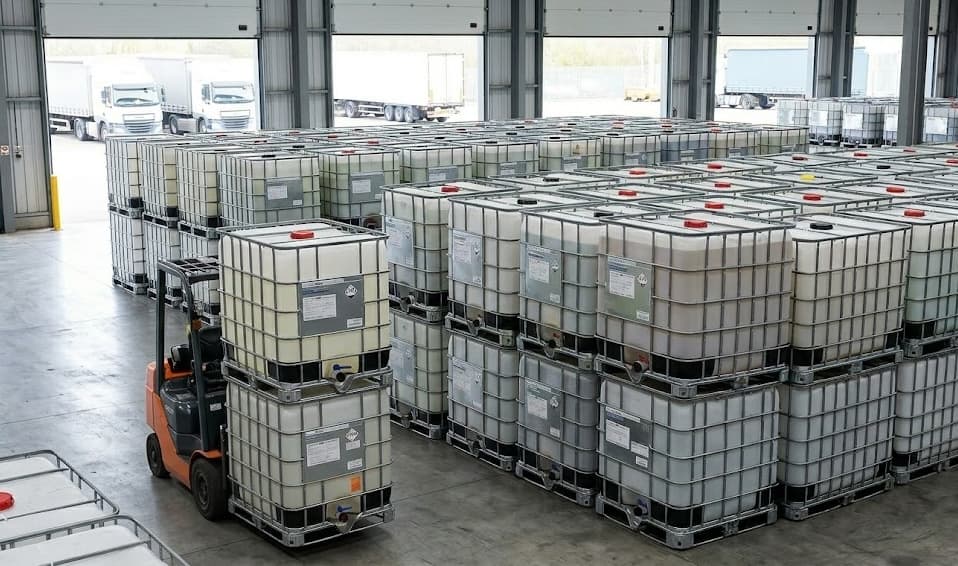
Eco Impact Calculator
See the real environmental impact of recycling IBC totes. Enter the number of totes you want to recycle and watch the savings add up in real time.
Ready to Make an Impact?
Contact us to start recycling your IBC totes and turn these numbers into reality.
Get Your Free Quote
Fill out the form and our team will get back to you within 24 hours with a customized solution.
0 of 8 required fields completed
What to Expect
Submit your request details
Receive a quote within 24 hours
Schedule pickup or delivery
Why Choose Us
Prefer to talk? Call us directly:
(313) 555-1234How Many IBC Totes Will You Recycle?
CO2 Prevented
Each recycled IBC tote prevents approximately 120 kg of carbon dioxide emissions that would be generated from manufacturing a new container from virgin materials.
Water Saved
Manufacturing a new IBC tote requires nearly 2,000 gallons of water for resin production, cooling, and processing. Recycling reduces water usage by over 99%.
Plastic Diverted
The average IBC bottle contains 62 pounds of HDPE plastic. Without recycling, this plastic would take over 450 years to decompose in a landfill.
Oil Conserved
Producing virgin HDPE resin requires approximately 2.5 barrels of crude oil per IBC tote. Recycling conserves this finite natural resource.
Trees Equivalent
The CO2 savings from recycling each IBC tote is equivalent to the annual carbon absorption of 5.5 mature trees. That's like planting a small grove for every tote.
Energy Saved
Manufacturing a new IBC tote from virgin materials requires approximately 285 kWh of electrical energy for resin production, blow molding, cage welding, and assembly. Recycling uses a fraction of this energy.
Landfill Space Saved
Each 275-gallon IBC tote takes up approximately 36.8 cubic feet of landfill space when not recycled. That space is preserved indefinitely since HDPE takes 450+ years to decompose.
Steel Recycled
The galvanized steel cage of a standard IBC tote weighs approximately 48 pounds. This steel is fully recyclable and can be melted down to make new products indefinitely without loss of quality.
Your Total Impact Summary
Recycling 10 IBC totes is equivalent to taking 0 cars off the road for a year.
What Does Your Impact Look Like?
It can be hard to visualize environmental metrics. Here are real-world equivalencies to put your recycling impact into perspective.
120 kg CO2 per tote / 0.41 kg CO2 per mile (average car) = 293 miles of driving avoided
285 kWh per tote / 1.44 kWh average US home consumption per hour = 198 hours of electricity
285 kWh per tote / 0.0195 kWh per smartphone charge = 14,625 full charges
1,985 gallons per tote / 20 gallons per average shower = 99 showers worth of water
62 lbs of HDPE per tote / 0.667 oz per plastic bottle = 1,488 standard 16.9 oz bottles
2.5 barrels of crude oil per tote x 42 gallons per barrel = 105 gallons of crude oil (approximately 50 gallons of refined gasoline equivalent)
IBC Recycling at Scale
The cumulative impact of IBC recycling is staggering. Here is what the numbers look like at various volumes, from a small business to an entire industry.
| Metric | 10 Totes | 100 Totes | 1,000 Totes | 10,000 Totes | 100,000 Totes |
|---|---|---|---|---|---|
| CO2 Prevented (kg) | 1,200 | 12,000 | 120,000 | 1,200,000 | 12,000,000 |
| CO2 Prevented (metric tons) | 1.2 | 12 | 120 | 1,200 | 12,000 |
| Water Saved (gallons) | 19,850 | 198,500 | 1,985,000 | 19,850,000 | 198,500,000 |
| Plastic Diverted (lbs) | 620 | 6,200 | 62,000 | 620,000 | 6,200,000 |
| Oil Conserved (barrels) | 25 | 250 | 2,500 | 25,000 | 250,000 |
| Trees Equivalent | 55 | 550 | 5,500 | 55,000 | 550,000 |
| Energy Saved (kWh) | 2,850 | 28,500 | 285,000 | 2,850,000 | 28,500,000 |
| Steel Recycled (lbs) | 480 | 4,800 | 48,000 | 480,000 | 4,800,000 |
| Landfill Space (cu ft) | 368 | 3,680 | 36,800 | 368,000 | 3,680,000 |
| Cars Off Road (1 year) | ~3 | ~28 | ~280 | ~2,800 | ~28,000 |
| Homes Powered (hours) | 1,980 | 19,800 | 198,000 | 1,980,000 | 19,800,000 |
New vs Recycled: Lifecycle Comparison
Understanding the full lifecycle impact of a new IBC tote versus a recycled one reveals why reuse and recycling are so critical for sustainability.
| Lifecycle Stage | New IBC (Virgin Materials) | Recycled / Reused IBC | Savings |
|---|---|---|---|
| Raw Material Extraction | 2.5 barrels crude oil + iron ore mining | Existing materials reused | 100% raw material reduction |
| Resin Production | 28 kg HDPE from petrochemical cracking | No new resin needed (or recycled pellets) | 85-100% virgin resin saved |
| Blow Molding (Bottle) | ~180 kWh energy, high-temp processing | Cleaning only (~5 kWh) | 97% energy reduction |
| Steel Cage Fabrication | ~105 kWh for welding, galvanizing | Inspection and touch-up only | 95%+ energy reduction |
| Water Usage | ~1,985 gallons (cooling, processing) | ~15 gallons (cleaning) | 99.2% water reduction |
| CO2 Emissions | ~120 kg CO2 equivalent | ~5-8 kg CO2 (transport + cleaning) | 93-96% CO2 reduction |
| Transportation | Factory to distributor to end user | Collection to recycler to end user | Often shorter distance (local) |
| End of Life | Landfill (450+ years to decompose) | Recycled again or material recovery | Zero landfill |
Tips for Greener IBC Practices
Follow these best practices to maximize the environmental benefit of your IBC tote usage and ensure the longest possible service life.
Drain Completely Before Return
Ensure your IBCs are fully drained before sending them for recycling. Residual product makes cleaning harder, uses more water, and may prevent the tote from being reused (downgrading it to material recycling only). A well-drained tote can often be cleaned and resold as Grade A, commanding the best resale value.
Keep Caps & Valves Closed
Always replace the fill cap and close the discharge valve after emptying. This prevents contamination from rain, debris, and insects, which can turn a Grade A tote into a Grade C. A clean, capped tote is much more likely to be reused rather than shredded, keeping it in the circular economy longer.
Store Indoors When Possible
UV radiation degrades HDPE over time, making the bottle brittle and unsuitable for reuse. Indoor storage extends the life of your IBCs by years. If outdoor storage is unavoidable, choose black-bottled IBCs for UV protection, or cover natural/white bottles with a tarp. Every additional reuse cycle prevents the manufacture of one new tote.
Use Compatible Products Only
Before filling an IBC, verify that the contents are chemically compatible with HDPE. Aggressive solvents (acetone, toluene, MEK) can swell, soften, or crack the bottle, rendering it non-recyclable for reuse. Using the wrong chemical can also contaminate the HDPE, making even material recycling (shredding/pelletizing) difficult due to cross-contamination.
Consolidate & Batch Pickups
If you generate used IBCs over time, accumulate them and schedule a single batch pickup rather than multiple small trips. A full truckload of 56 empty totes has a much lower per-tote carbon footprint for transportation than multiple partial loads. We offer free pickup for 20+ totes within our service area, making consolidation financially smart too.
Consider Rebottling Over Replacement
When your IBC bottle reaches end of life but the cage and pallet are still in good condition, choose rebottling instead of buying a completely new IBC. Rebottling replaces only the HDPE inner bottle (28 kg of plastic) while preserving the steel cage (48 lbs of steel) and pallet. This saves approximately 60% of the environmental impact compared to manufacturing a brand-new IBC.
Track & Document Contents
Label your IBCs with the product they contained. Totes with known, documented previous contents are worth significantly more because they can be confidently reused. An unlabeled tote must be treated as potentially contaminated, limiting its reuse options and often resulting in material recycling only. Good documentation keeps more totes in circulation.
Protect the Valve & Gaskets
The valve and gaskets are the most frequently replaced parts on an IBC. Handle the valve carefully — don't use it as a step or handhold. Always use the dust cap when the tote is not connected to a hose. Replace gaskets at the first sign of weeping or hardening rather than waiting for a full leak. New gaskets cost a few dollars; a contaminated product batch costs thousands.
Choose Recycled Over New
For non-food, non-hazmat applications, buying a used Grade A or B IBC tote is the single most impactful sustainability decision you can make. Used totes cost 50-80% less than new and deliver the same functional performance for most applications. By creating demand for used totes, you support the entire recycling ecosystem and send a market signal that reuse has value.
Our Calculation Methodology
We believe in transparency. Here's how we calculate each environmental metric, including data sources and assumptions.
CO2 Emissions (120 kg/tote)
Based on lifecycle analysis of HDPE resin production from crude oil, including extraction, refining, polymerization, blow molding, cage fabrication, and transportation. Data sourced from EPA emission factors for plastics manufacturing (EPA 430-R-23-002) and the American Chemistry Council's lifecycle inventory database.
- HDPE resin production: ~72 kg CO2
- Blow molding process: ~18 kg CO2
- Steel cage fabrication: ~22 kg CO2
- Transportation (average): ~8 kg CO2
Water Usage (1,985 gal/tote)
Accounts for water consumed in crude oil extraction and refining, steam cracking of ethylene, HDPE polymerization, cooling processes during blow molding, and steel production for the cage frame. Based on Water Footprint Network data and USGS industrial water use reports.
- Crude oil extraction & refining: ~580 gal
- Ethylene cracking & HDPE polymerization: ~720 gal
- Blow molding cooling: ~285 gal
- Steel production (cage): ~400 gal
Plastic Weight (62 lbs/tote)
The average weight of the HDPE inner bottle in a standard 275-gallon IBC tote. This figure is derived from weighing thousands of bottles during our recycling process. Range is typically 50-70 lbs depending on manufacturer and wall thickness.
- 110 gallon: 25-35 lbs
- 180 gallon: 38-48 lbs
- 275 gallon: 55-65 lbs (avg 62)
- 330 gallon: 65-78 lbs
Oil Consumption (2.5 barrels/tote)
HDPE production requires approximately 1.75 kg of crude oil per 1 kg of finished polymer. For a 62 lb (28 kg) HDPE bottle, this equates to roughly 49 kg of crude oil (approximately 2.5 barrels at 42 gallons per barrel, accounting for refining losses and energy inputs).
- 28 kg HDPE x 1.75 kg oil/kg HDPE = 49 kg oil
- 49 kg oil / ~136 kg per barrel = ~0.36 barrels (feedstock)
- Energy input for processing: ~2.14 barrels equivalent
- Total: ~2.5 barrels crude oil per tote
Energy Usage (285 kWh/tote)
Total electrical and thermal energy required to manufacture a new IBC tote, converted to kilowatt-hour equivalents. Includes resin production, blow molding, cage welding and galvanizing, pallet manufacturing, and assembly. Based on energy audit data from plastics industry associations.
- HDPE resin production: ~155 kWh
- Blow molding: ~45 kWh
- Cage welding & galvanizing: ~65 kWh
- Assembly & QC: ~20 kWh
Tree Equivalence (5.5 trees/tote)
A mature deciduous tree absorbs approximately 22 kg (48 lbs) of CO2 per year. With 120 kg of CO2 prevented per recycled tote, the equivalent is approximately 5.5 trees absorbing carbon for one full year. Based on USDA Forest Service data on carbon sequestration rates for common North American tree species.
- Average tree CO2 absorption: 22 kg/year
- 120 kg CO2 / 22 kg per tree = 5.45 trees
- Rounded to 5.5 trees for simplicity
- Species reference: Oak, Maple, Birch (USDA Forest Service)
Steel Recycled (48 lbs/tote)
The average weight of the galvanized steel cage on a standard 275-gallon IBC. Steel is infinitely recyclable without degradation. The energy savings from recycling steel versus producing from iron ore is approximately 74%, with a proportional reduction in CO2 emissions.
- Energy saved: ~40 kWh (vs virgin steel)
- CO2 prevented: ~22 kg (included in total)
- Iron ore conserved: ~72 lbs
- Coal conserved: ~32 lbs
Landfill Space (36.8 cu ft/tote)
Based on the physical volume of a standard 275-gallon IBC tote (48" x 40" x 46" = 36.8 cubic feet). While landfill compaction may reduce this somewhat, the practical volume saved is significant because HDPE does not biodegrade meaningfully — it will persist for 450+ years, effectively occupying that space permanently.
- 1,000 totes = 36,800 cu ft = ~1,363 cubic yards
- That's roughly 136 standard dump truck loads
- Or a cube measuring 33 ft x 33 ft x 33 ft
Data Sources & Assumptions
- - EPA Emission Factors Hub (2023 edition) — EPA 430-R-23-002
- - American Chemistry Council — Lifecycle Inventory of HDPE Resin (2022)
- - Water Footprint Network — Industrial Water Use Database
- - USGS — Estimated Use of Water in the United States (2020 Circular 1441)
- - USDA Forest Service — Carbon Sequestration by Urban Trees (Gen. Tech. Rep. NRS-52)
- - AISI (American Iron and Steel Institute) — Steel Recycling Energy Savings Data
- - All calculations assume a standard 275-gallon composite IBC (UN 31HA1)
- - "Cars off the road" calculation: Average US car emits 4.6 metric tons CO2/year (EPA)
- - Recycling process energy (cleaning, transport) is subtracted from gross savings
- - Figures are conservative estimates; actual savings may be higher for specific scenarios
Turn Numbers into Action
Every IBC tote recycled makes a real difference. Get started with IBC Recycling Detroit today.