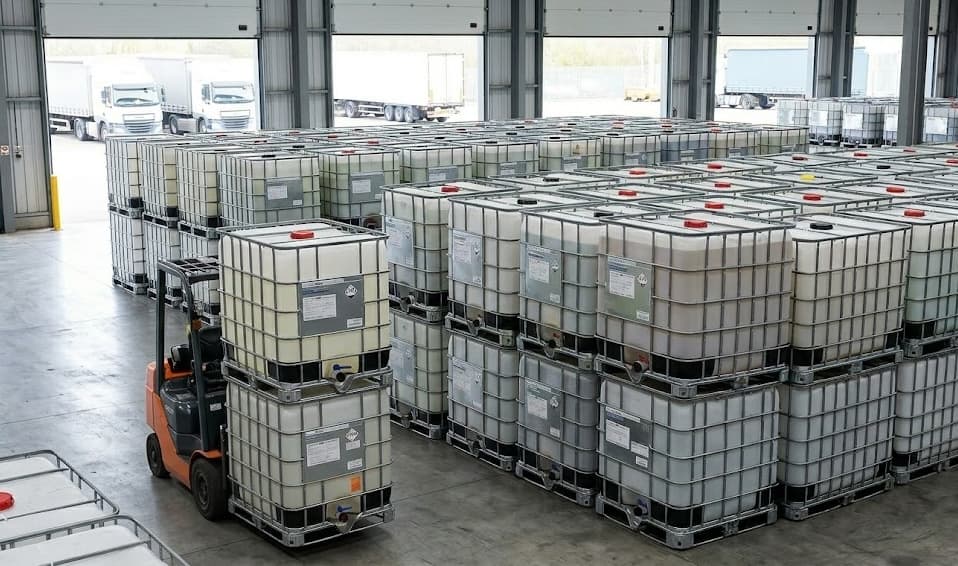
If your business stores or transports hazardous materials in IBC totes, understanding UN/DOT ratings is not optional — it's a legal requirement. Non-compliance can result in fines up to $75,000 per violation and potential criminal liability if an incident occurs. This guide breaks down everything you need to know to stay compliant.
What Are UN/DOT Ratings?
The United Nations developed a standardized system for classifying and testing packaging for dangerous goods back in 1956, and it has been continually updated since. In the United States, the Department of Transportation (DOT) enforces these standards through 49 CFR Parts 171-180. Any container used to transport hazardous materials across public roads must be UN-tested and certified by an approved laboratory.
Decoding the UN Marking
Every UN-certified IBC carries a permanent marking (usually molded or stamped on the bottle and/or cage). Here's how to read a typical marking:
UN 31HA1/Y/1.5/150/26 03/USA/MAUSER/10-1234
Breaking this down piece by piece: "UN" indicates UN-certified packaging. "31" is the IBC code meaning rigid IBC for liquids. "H" indicates the inner container material, with H meaning plastic. "A1" is the outer cage type where A means steel and 1 means welded frame. "Y" is the Packing Group designation where X handles Groups I, II, and III, Y handles Groups II and III, and Z handles Group III only. "1.5" is the maximum specific gravity of contents. "150" is the hydrostatic test pressure in kPa. "26 03" is the month and year of manufacture. "USA" is the country where certified. "MAUSER" is the manufacturer name. And "10-1234" is the serial or lot number.
Packing Groups Explained
Hazardous materials are classified into three Packing Groups based on danger level:
Packing Group I represents Great Danger and requires X-rated IBCs. These are the most robust containers, tested to the highest standards. Examples include concentrated sulfuric acid and certain highly toxic substances. Packing Group II represents Medium Danger and requires Y-rated or X-rated IBCs. This is the most common rating for industrial chemicals. Examples include most flammable liquids and corrosive solutions at moderate concentrations. Packing Group III represents Minor Danger and Z-rated, Y-rated, or X-rated IBCs are sufficient. Examples include dilute corrosive solutions and combustible liquids with higher flash points.
The 5-Year Rule
This is the most commonly misunderstood aspect of UN-rated IBCs. Composite IBCs (type 31HA1) have a maximum service life of 5 years from the date of manufacture for hazardous material use. This is a hard deadline — it does not matter how good the IBC looks or how well it has been maintained. The plastic undergoes molecular-level degradation that cannot be visually assessed.
After 5 years, you have three options: Requalification where an authorized testing facility inspects and retests the IBC and if it passes, it receives a new marking allowing continued use for 2.5 additional years. Rebottling where the old bottle is replaced with a new UN-rated bottle in the existing cage, and the new manufacture date starts a fresh 5-year clock. Or Retirement where you remove the IBC from hazmat service noting it can still be used for non-hazardous applications indefinitely.
Inspection Requirements
Even within the 5-year service life, every UN-rated IBC must be inspected before each refilling. The inspection must verify no cracks, warping, or crazing in the bottle, no structural damage to the cage, all welds intact with no corrosion, the valve operates correctly and seals properly, gaskets are in good condition without swelling or hardening, the UN marking is legible, and the date has not expired.
Failed inspections must be documented and the IBC must be repaired, requalified, or retired. Do not put a failed IBC back into hazmat service under any circumstances.
Common Violations and Penalties
DOT enforcement has increased significantly in recent years with the implementation of electronic inspection tools and expanded roadside check programs. The most common violations we see include using expired IBCs for hazmat with fines of $10,000-$50,000 per occurrence, missing or illegible UN markings with fines of $5,000-$25,000, failure to inspect before refilling with fines of $5,000-$25,000, wrong packing group rating with fines of $10,000-$75,000, and using non-UN-rated containers for hazmat with fines of $25,000-$75,000 or more.
Record Keeping Requirements
DOT requires that shippers maintain records of all IBC inspections, test results, and certifications. These records must be kept for at least 2 years after the IBC is retired from hazmat service. Many companies fail this requirement simply because they lack a tracking system.
How IBC Recycling Detroit Can Help
We maintain detailed records of every IBC tote we process, including UN certification dates, previous contents, and inspection results. When you purchase a UN-rated IBC from us, you receive a certificate of inspection, verified manufacture date, confirmed packing group rating, documentation of previous contents, and a guarantee of leak-free performance.
We also offer UN date tracking services for fleets — we'll notify you 90 days before any of your IBCs expire, giving you time to plan for replacement or requalification. Don't risk non-compliance. Contact us today for UN-rated IBCs with verified documentation.