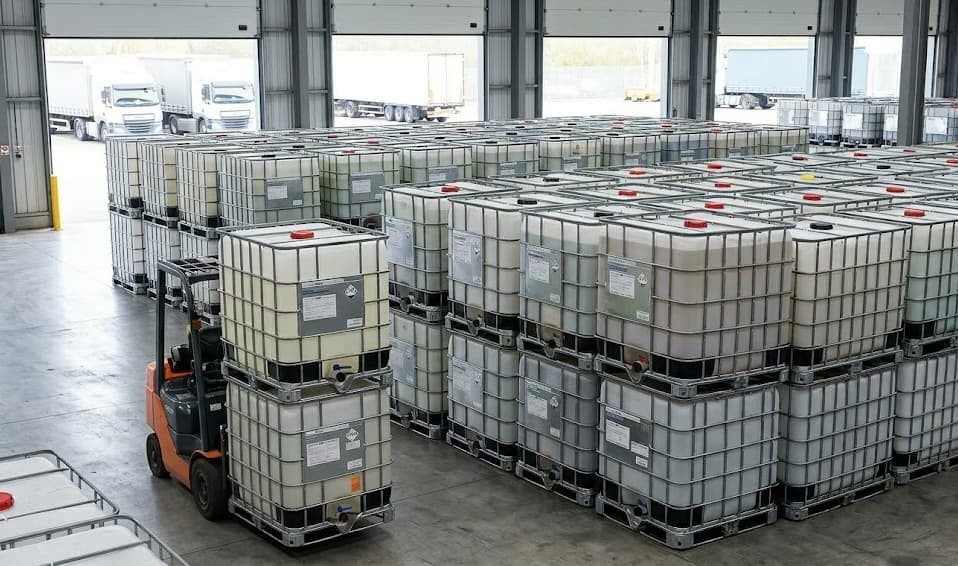
Environmental, Social, and Governance (ESG) reporting has moved from a nice-to-have to a business imperative. Investors, customers, and regulators increasingly demand quantifiable environmental performance data. If your business recycles, reuses, or purchases reconditioned IBC totes, you have a compelling sustainability story to tell — but only if you can back it up with credible numbers. This guide shows you exactly how to calculate and report your IBC recycling impact.
Why IBC Metrics Matter for ESG
IBC tote recycling touches several key ESG reporting frameworks. Under GRI (Global Reporting Initiative) Standards, it maps to GRI 301 (Materials), GRI 305 (Emissions), and GRI 306 (Waste). Under CDP (Carbon Disclosure Project), it contributes to Scope 3 emissions reductions. Under SASB (Sustainability Accounting Standards Board), it affects resource efficiency metrics. And under TCFD (Task Force on Climate-related Financial Disclosures), it demonstrates transition risk management.
Having concrete, methodology-backed IBC recycling metrics strengthens your reporting across all these frameworks.
Carbon Emission Calculations
The carbon impact of IBC recycling can be calculated using lifecycle assessment (LCA) methodology. The key data points are:
Manufacturing emissions for a new 275-gallon composite IBC are approximately 120 kg CO2e. This includes raw material extraction and processing (HDPE resin production from crude oil = 65 kg CO2e), manufacturing energy for blow molding, cage welding, and assembly equaling 35 kg CO2e, and transportation of finished goods to market at 20 kg CO2e.
When you purchase a reconditioned IBC instead of new, you avoid the manufacturing emissions entirely. The reconditioning process (cleaning, inspection, gasket replacement) generates approximately 8-12 kg CO2e, primarily from water heating and transportation.
Net carbon savings per reconditioned IBC: 120 - 10 (average reconditioning) = 110 kg CO2e avoided.
For your report: multiply the number of reconditioned IBCs purchased by 110 kg to get your total avoided emissions. Example: 200 reconditioned IBCs purchased = 22,000 kg (22 metric tons) CO2e avoided.
Water Conservation Metrics
Virgin HDPE production is water-intensive. Manufacturing one new IBC bottle requires approximately 1,800-2,200 gallons of water across the supply chain (oil extraction cooling, refinery processes, resin production, and blow molding cooling).
IBC reconditioning (triple-rinse cleaning) uses approximately 40-60 gallons of water per unit, which is treated and largely recycled in closed-loop systems at professional facilities.
Net water savings per reconditioned IBC: approximately 1,950 gallons (using midpoint estimates).
For your report: 200 reconditioned IBCs x 1,950 gallons = 390,000 gallons of water conserved.
Waste Diversion Metrics
Each recycled or reused IBC keeps the following materials out of landfills: HDPE plastic bottle at 55-65 lbs, galvanized steel cage at 50-60 lbs, plastic or wood pallet at 30-45 lbs, and valve and fittings at 3-5 lbs. Total material diverted per IBC: 138-175 lbs (using 155 lbs average).
For your report: 200 IBCs recycled or reused x 155 lbs = 31,000 lbs (15.5 tons) of material diverted from landfill.
Petroleum Conservation
Virgin HDPE production requires crude oil as both feedstock (the carbon in the plastic) and process energy. Approximately 2.5 barrels of oil are consumed in producing one IBC bottle's worth of HDPE resin.
For your report: 200 reconditioned IBCs purchased = 500 barrels of crude oil conserved.
Reporting Best Practices
When including IBC recycling metrics in your sustainability report, follow these best practices for credibility. State your methodology clearly and reference lifecycle assessment sources for the per-unit factors you're using. Distinguish between totes reused (greatest environmental benefit) and totes materially recycled (still beneficial but less so). Be conservative and use lower-bound estimates rather than upper-bound to maintain credibility. Provide year-over-year trends to show whether your program is growing or static. Separate your own direct actions (purchasing reconditioned, selling used for recycling) from supply chain impacts. And get verification if possible — third-party assurance of sustainability data dramatically increases stakeholder confidence.
Documentation for Auditors
Maintain the following records to support your reported metrics: purchase orders for reconditioned IBCs with quantities, dates, and supplier, sales records for used IBCs sent for recycling with quantities and dates, recycling certificates from your IBC recycler (we provide these), methodology documentation showing your per-unit factors and their sources, and any third-party verification or certification of your recycling program.
IBC Recycling Detroit's Support
We provide all customers with annual impact certificates documenting the total environmental benefit of their transactions with us. These certificates include total IBCs purchased reconditioned, total IBCs sold for recycling, calculated CO2, water, and waste metrics using the methodology described above, and a statement suitable for inclusion in sustainability reports.
Contact us to discuss how we can support your ESG reporting with documented, verifiable IBC recycling metrics.