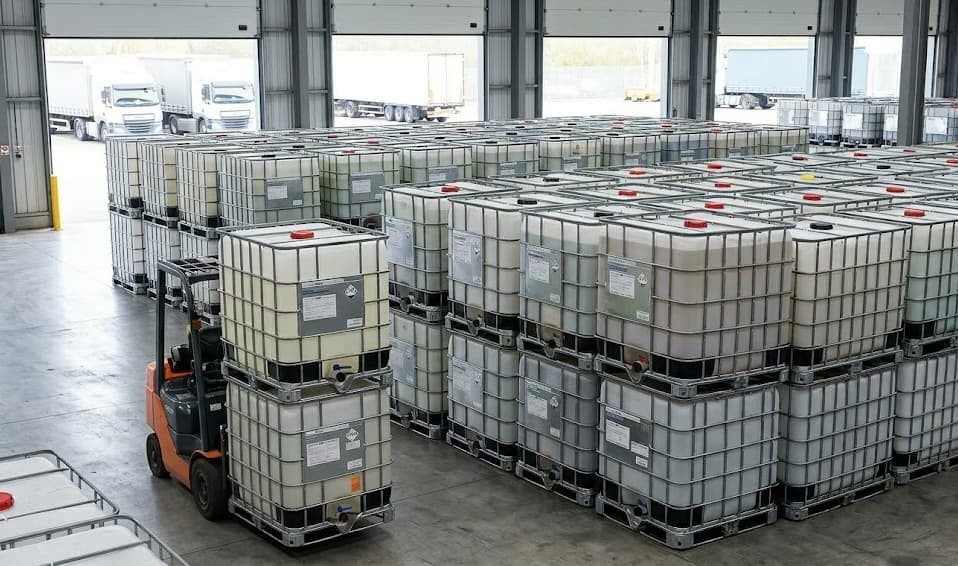
Cross-contamination — residual material from a previous fill affecting a subsequent fill — is the single greatest risk associated with reusing IBC totes. A few parts per million of the wrong substance can render an entire batch unusable, trigger a product recall, violate regulatory requirements, or create a safety hazard. This guide provides a systematic approach to eliminating that risk.
Understanding Contamination Sources
Cross-contamination in reused IBCs comes from several sources that must all be addressed:
Residual product physically remaining in the container is the most obvious source. Even after "complete" drainage, IBC totes retain 0.5-2 liters of product in the bottom contours, valve assembly, and wall adhesion. For products with specific gravity greater than 1.0, residual quantities can be even higher due to settling in low spots.
Absorbed contamination occurs because HDPE is semi-porous at the molecular level. Small molecules (particularly solvents, essential oils, and aromatic compounds) can migrate into the polymer matrix during storage and then leach back out into subsequent fills. This type of contamination is invisible and cannot be addressed by surface cleaning alone.
Biofilm contamination develops when containers that held organic products (foods, natural oils, agricultural products) sit empty with residual moisture, creating conditions for bacterial or fungal colonies to establish in surface micro-textures that resist casual cleaning.
Component contamination occurs in valves, gaskets, and cap seals which can harbor trapped product in internal passages and O-ring grooves, then release it during subsequent use.
Risk Assessment Matrix
Not all product transitions carry equal risk. Consider the worst-case scenario for each changeover:
High risk transitions include hazardous chemical to food product, allergen-containing product to allergen-free product, strong flavor or odor to neutral product, and incompatible chemicals where reaction could occur.
Moderate risk transitions include different food products (flavor transfer), similar chemicals in different concentrations, and products with different quality specifications.
Low risk transitions include identical products between different batches, water to similar water-based product, and chemically compatible products where traces are harmless.
Your cleaning validation requirements should match the risk level. High-risk transitions may require analytical testing; low-risk transitions may only need visual and olfactory verification.
Cleaning Validation Methods
Visual Inspection
The minimum standard for all transitions. The interior surface should appear clean and free of discoloration, residue, or film when illuminated with a bright flashlight. All surfaces should be checked, including the underside of the top cap area, inside the valve bore, and the bottom contours where product pools.
Water Break Test
After the final rinse, observe how water behaves on the interior surface. On a truly clean HDPE surface, water will sheet uniformly without beading or breaking. If water beads up or breaks into droplets, organic residue remains on the surface and additional cleaning is needed.
Conductivity Testing
For transitions from ionic products (salts, acids, bases) to pure or sensitive products, measure the conductivity of the final rinse water. Compare to your incoming rinse water baseline. Elevated conductivity indicates dissolved contaminants remain. Continue rinsing until conductivity matches baseline within acceptable tolerance.
pH Testing
Similar to conductivity, pH measurement of final rinse water can detect acidic or alkaline residues. The final rinse should be within 0.5 pH units of your rinse water source.
Analytical Testing (GC, HPLC, ICP)
For high-risk transitions (especially involving allergens, pharmaceuticals, or hazardous chemicals), instrumental analysis of rinse water or surface swabs provides definitive proof of cleanliness. Gas chromatography (GC) detects organic solvents and volatile compounds. High-performance liquid chromatography (HPLC) detects non-volatile organics. And inductively coupled plasma (ICP) spectroscopy detects dissolved metals.
These tests require laboratory equipment and expertise but provide legally defensible evidence of adequate cleaning.
Documentation Requirements
For regulated industries (food, pharmaceutical, chemical), cleaning documentation typically must include the identity of the previous contents, the cleaning procedure performed including chemicals, temperatures, and contact times, rinse water test results with acceptance criteria, identity of the person who performed cleaning and inspection, date and time of cleaning completion, and approval or release for refilling.
This documentation creates the traceability chain that proves due diligence in the event of a contamination incident. Without it, you have no defense.
IBC Recycling Detroit's Approach
Every tote we recondition receives documented cleaning with full traceability. We record previous contents (verified from customer documentation), cleaning chemical identity and concentration, wash water temperature and contact time, rinse water volume (minimum 3x container volume), final rinse conductivity measurement, visual inspection results, valve and gasket replacement records, and final grade assignment with inspector signature.
When you purchase a reconditioned IBC from us, this documentation comes with it. You know exactly what was in the container before, exactly how it was cleaned, and exactly what testing verified its cleanliness. That's the level of assurance your quality system requires.
The Bottom Line
Cross-contamination is a preventable problem. It requires systematic cleaning procedures, appropriate validation testing matched to risk level, complete documentation, and trained personnel who understand the consequences of shortcuts. Cutting corners on cleaning saves minutes but can cost thousands — or even destroy customer relationships and business reputation.
If cleaning and validation feel overwhelming to manage in-house, partner with a professional reconditioning facility that does this all day, every day. That's exactly what we do at IBC Recycling Detroit.