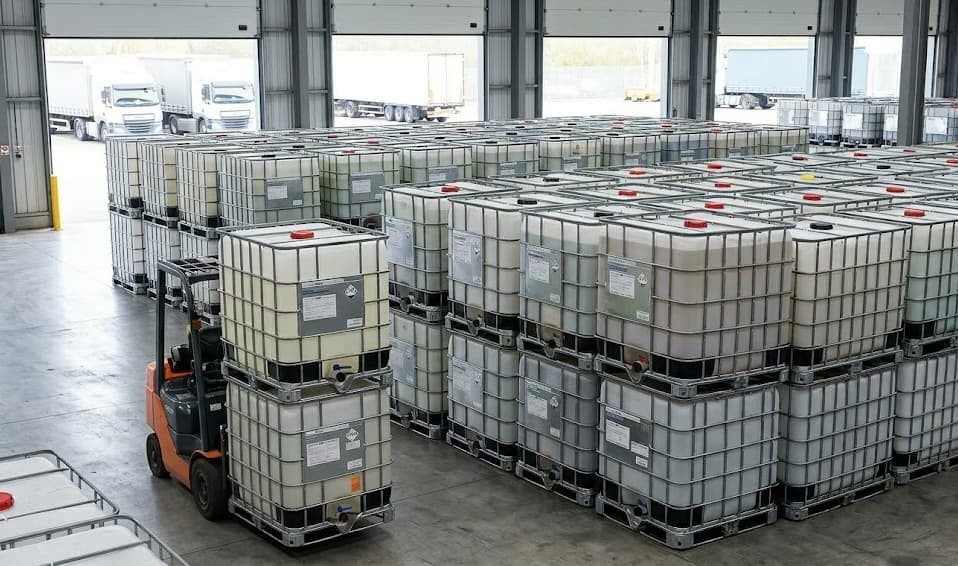
Michigan's diverse agricultural landscape — from cherry orchards in Traverse City to dairy farms in the Thumb to row crops in the southern tier — creates enormous demand for affordable, versatile liquid storage and handling containers. IBC totes have become indispensable on farms of all sizes. Here are fifteen essential agricultural applications.
Liquid Fertilizer Storage and Application
Perhaps the most common agricultural use. Farms purchase liquid fertilizers (UAN-28, UAN-32, 10-34-0, potassium solutions) in bulk and store them in IBCs for use throughout the growing season. The built-in valve makes connecting to nurse tanks or spray equipment simple. Multiple IBCs can be manifolded together for larger storage capacity without the cost of a fixed tank installation.
Cost savings are substantial. Buying fertilizer in bulk IBC quantities (275 gallons) versus retail jugs or drums can save 20-40% per gallon. For a 500-acre corn operation using 8-10 gallons per acre of liquid starter fertilizer, that's thousands of dollars annually.
Pesticide and Herbicide Mixing
IBC totes serve as excellent batch mixing tanks for crop protection chemicals. The enclosed design prevents evaporation and contamination during mixing, and the bottom valve allows direct connection to sprayer fill systems. The cage provides a mounting point for portable agitation systems to keep suspensions mixed.
Important safety note: always use IBCs rated for chemical storage and never mix incompatible chemicals. Maintain strict labeling showing current contents and concentration. Rinse triple before changing products.
Livestock Water Supply
Cattle, horses, dairy cows, goats, sheep, and poultry all need reliable water access. IBCs positioned at pasture locations provide high-capacity water supply that lasts days rather than requiring daily refilling. Connected via float valve to drinking troughs, a single 275-gallon IBC keeps water flowing to a 100-gallon trough for nearly three days even for a group of 20 cattle.
For remote pastures without water lines, IBCs are transported full on pickup trucks or trailers and gravity-fed to troughs through the bottom valve. The cage protects the container from animal rubbing and impact.
Maple Sap Collection
Michigan ranks fourth nationally in maple syrup production, and IBC totes have revolutionized sap collection for producers at all scales. Traditional bucket collection requires visiting every tree daily during the 4-6 week sugaring season. Tubing systems connected to IBC collection tanks at the bottom of slopes allow gravity flow from dozens of trees to a single container. When full, the IBC is transported by tractor to the sugar house.
For a 100-tap operation, two IBCs provide approximately one day's collection capacity during peak sap flow. The transparent or translucent HDPE allows visual monitoring of fill level from a distance.
Irrigation Water Storage
Farms without wells at field locations use IBCs for portable irrigation water. Filled from the main well and transported to wherever water is needed — greenhouse starting, transplant watering, livestock pasture, or remote crop areas not served by permanent irrigation.
Multiple IBCs manifolded together with a solar-powered pump create an autonomous drip irrigation system for high-value crops like berries, vegetables, and nursery stock without the cost of trenching permanent water lines.
Cider and Juice Production
Michigan's apple and cherry producers use food-grade IBCs for storing pressed juice and cider during production. The large volume reduces container handling compared to barrels, and the sealed system prevents oxidation and contamination. Wineries and meaderies also use them for must storage and fermentation of large batches.
Liquid Livestock Feed
Molasses-based livestock feed supplements, liquid whey from dairy processing, and fat supplements are all stored and dispensed from IBCs on farms. The viscous nature of these products benefits from the large bottom valve opening (compared to drums) and the optional heating blankets that keep them flowing in cold weather.
Milk Cooling Water Recycling
Dairy farms generate thousands of gallons of warm water daily from milk cooling (plate coolers). Rather than sending this heat energy down the drain, progressive farms capture it in IBCs for preheating wash water, warming livestock drinking water in winter, or greenhouse heating. Each IBC holds enough thermal energy to meaningfully heat a small greenhouse for several hours.
Crop Sprayer Nurse Tank
During intensive spraying periods (spring herbicide applications, summer fungicide passes), the speed of refilling sprayers determines how many acres can be covered per day. IBCs serve as mobile nurse tanks that ride alongside the sprayer on dedicated trailers, allowing field-side refilling in minutes rather than returning to the barn for each reload. This alone can increase daily spraying capacity by 30-40%.
Manure Tea Brewing
Organic and low-input farms brew manure tea (diluted composted manure steeped in water with aeration) as a biological fertilizer and soil inoculant. IBCs provide the perfect brewing vessel — large enough for meaningful batch production, with a valve for dispensing, and durable enough for years of messy agricultural use.
Fish Transport
Aquaculture operations and fisheries management agencies use IBCs for transporting live fish. Equipped with battery-powered aerators and temperature monitoring, IBCs safely carry catfish, trout, bass, and other species between hatcheries, stocking locations, and grow-out facilities. The cage protects the container during rough farm road transport.
Seed Treatment Application
Large-scale grain farms apply liquid seed treatments (fungicides, insecticides, inoculants) to seeds before planting. IBCs store these concentrated products and feed them to seed treating equipment at controlled rates. The enclosed system prevents operator exposure to agricultural chemicals during the treating process.
Emergency Fuel Storage
Farms in rural areas often maintain diesel fuel reserves for equipment during planting and harvest when fuel demand peaks. While permanent fuel tanks require permits and secondary containment infrastructure, IBC-based fuel storage (using appropriate container ratings) provides flexible, temporary capacity that can be scaled up during busy seasons and removed when not needed.
Winery Wastewater Management
Michigan's growing wine industry generates significant wastewater from crushing, pressing, and cleaning operations. IBCs serve as collection and settlement tanks before the wastewater is land-applied (a common permitted disposal method for winery effluent). The bottom valve allows clean drainage of settled supernatant while solids remain for separate disposal.
Compost Tea and Biological Inoculants
Beyond manure tea, advanced biological farming systems use IBCs to brew and store various microbial inoculants — mycorrhizal fungi preparations, bacillus-based biocontrol agents, and compost tea concentrates. The enclosed system maintains anaerobic or aerobic conditions as needed, and the food-grade HDPE doesn't inhibit biological activity.
Getting Agricultural IBCs
For farm use, Grade B and Grade C IBCs from IBC Recycling Detroit provide excellent value. Food-grade is only necessary for direct contact with products destined for human consumption (juice, cider, drinking water). For all other agricultural applications — fertilizer, chemicals, livestock water, non-food storage — industrial-grade containers at lower cost perform identically.
We also offer volume discounts for farms purchasing 10 or more units, and we can arrange delivery throughout Michigan's agricultural regions. Contact us to discuss your farm's container needs.