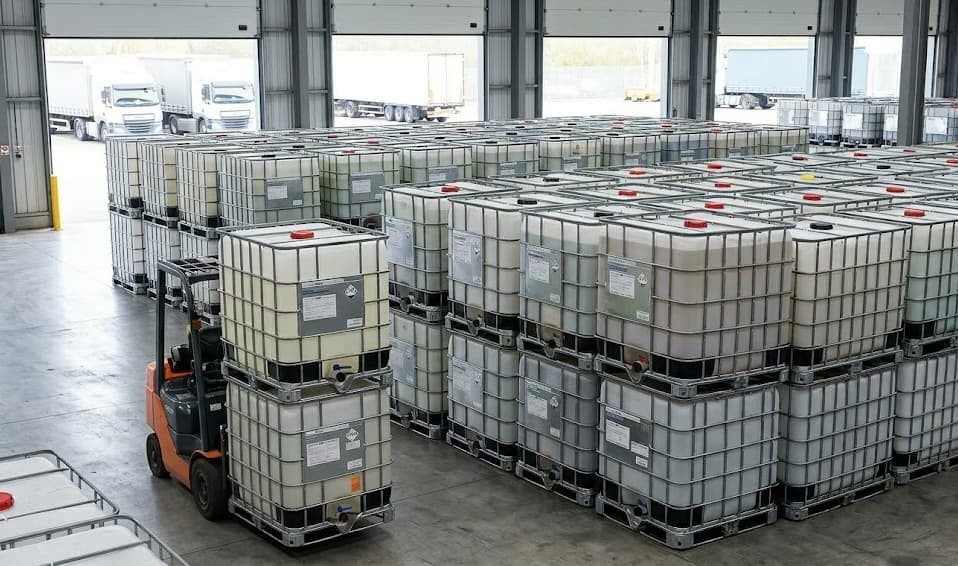
Moving IBC totes by truck, rail, or ocean freight involves more regulation and planning than most businesses initially expect. Between DOT securement requirements, hazmat placarding rules, weight limits, and loading best practices, there's a lot to get right. This comprehensive guide covers the freight logistics of IBC transportation.
Weight and Loading Basics
A standard 53-foot dry van trailer has the following relevant specifications: interior length of 52 feet 6 inches, interior width of 99 inches, interior height of 108-110 inches, maximum payload of 44,000-45,000 pounds (varies by tractor weight), and a floor rated for 16,000 pounds concentrated load.
A standard 275-gallon IBC has a 48 by 40 inch footprint. Loaded two-across (wide side facing trailer sidewalls), you fit exactly 2 IBCs across the trailer width (2 x 40 inches = 80 inches, within 99-inch interior). Loaded lengthwise, you fit 13 rows of 2 IBCs = 26 IBCs per trailer layer.
For single-stack loading, 26 IBCs per trailer. For double-stack (allowed for most composite IBCs per manufacturer specs), 52 IBCs per trailer. However, double-stacking full IBCs often exceeds weight limits before space runs out.
Weight Limit Calculations
Here's where many shippers get caught. 26 full 275-gallon IBCs (single stack) at 2,425 lbs each equals 63,050 lbs — well over the typical 44,000-45,000 lb payload limit. In practice, you can only load about 18 full IBCs per trailer before hitting weight limits (18 x 2,425 = 43,650 lbs).
For lighter products (specific gravity less than 1.0), you get more per truck. For heavier products (concentrated chemicals, some food products), you get fewer. Always calculate based on actual product weight, not just container count.
Empty IBCs are a different story. At 130-145 lbs each, you can load the full 52-unit double stack (approximately 7,500 lbs total) without approaching weight limits. This is why empty IBC transportation is remarkably efficient.
DOT Securement Requirements
FMCSA regulation 49 CFR 393 Subpart I governs cargo securement. For IBC totes specifically, the requirements state that cargo must be immobilized or secured to prevent shifting in any direction. For articles that are not unitized or palletized (which includes individual IBCs), the securement system must provide both forward and rearward restraint.
In practice, this means IBCs loaded into a trailer must be blocked against the headboard or bulkhead (prevents forward movement during braking), loaded tight against each other side-to-side (prevents lateral movement), and secured against rearward movement (usually by loading full to the door, or by using load bars and strapping).
Additionally, the aggregate working load limit (WLL) of all securement devices must equal at least 50% of cargo weight. For a 43,000-lb load, you need securement devices with combined WLL of at least 21,500 lbs.
Hazmat Shipping Requirements
When IBCs contain (or previously contained and aren't RCRA-empty) hazardous materials, additional requirements apply. The shipper must classify the material per 49 CFR 172.101, apply proper DOT labels and markings to each IBC, prepare shipping papers with proper descriptions, provide emergency response information, and ensure the driver has appropriate hazmat endorsement.
The carrier must placard the trailer per 49 CFR 172 Subpart F (based on quantity and hazard class), maintain the driver's hazmat training documentation, carry the shipping papers in the cab during transport, and follow routing restrictions for certain hazard classes.
Even for "residue" shipments (RCRA-empty containers being returned for recycling), some placarding and documentation requirements may apply depending on the last contents. Consult 49 CFR 173.29 for residue shipping requirements.
Cost Optimization Strategies
Freight costs for IBC shipments can be significant. Here are proven strategies to reduce them:
Maximize cube utilization by loading empties double-stacked whenever possible. Getting 52 empty IBCs on one truck instead of 26 cuts your per-unit freight cost in half.
Consolidate shipments by accumulating IBCs until you have a full truckload rather than shipping partial loads. LTL (less-than-truckload) rates for IBCs are disproportionately expensive because of their size relative to weight.
Negotiate based on lanes with consistent volume. If you're shipping to or from the same locations regularly, dedicated lane rates are significantly cheaper than spot market pricing.
Consider backhaul opportunities. If you're buying new/reconditioned IBCs from us AND selling us your empties, we can often arrange round-trip logistics that reduce total freight cost for both movements.
Return empty IBCs flat-packed or nested where possible. Some IBC designs allow cage folding when the bottle is removed, dramatically reducing return freight volume.
Documentation Checklist
For every IBC freight shipment, ensure you have a bill of lading with accurate weight, piece count, and commodity description, hazmat shipping papers if applicable, a load securement plan or checklist, proof of insurance (carrier's cargo coverage), NMFC freight class designation (usually 70 for IBCs), and any receiver-required documentation such as PO numbers and appointment confirmations.
Working with IBC Recycling Detroit
We handle IBC transportation logistics daily — both inbound (picking up used totes from your facility) and outbound (delivering reconditioned containers). Our fleet operates throughout Michigan and neighboring states, and we offer scheduled pickup services for regular generators, consolidated delivery for volume orders, competitive freight rates due to our volume, proper securement and handling by trained IBC-specific drivers, and full documentation and compliance for all shipments.
Contact us to discuss your transportation needs. Whether you need a single tote picked up or regular fleet service, we have the logistics infrastructure to help.