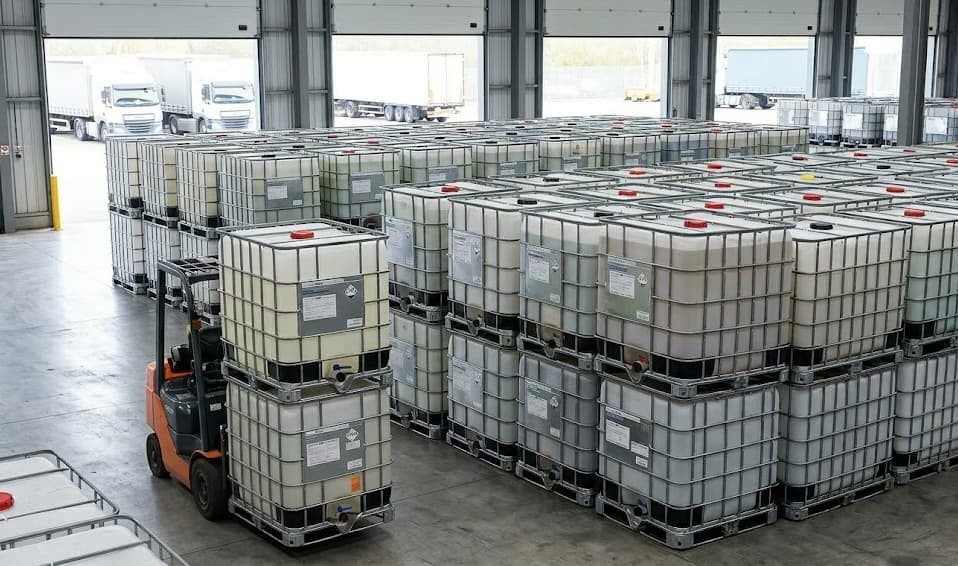
When people think about recycling, they often focus exclusively on environmental benefits. But the economic impact of recycling — particularly industrial recycling at the scale of IBC totes — is equally significant and often overlooked. Here's how IBC tote recycling contributes to Michigan's local economy in ways that extend far beyond our facility.
Direct Employment
IBC recycling is labor-intensive work that creates stable, skilled jobs in the communities where it operates. Our facility in Sterling Heights employs workers in roles including inspection and grading specialists, cleaning and reconditioning technicians, welding and cage repair professionals, logistics and transportation drivers, sales and customer service staff, and quality control and compliance managers.
These are full-time positions with benefits — not seasonal or temporary work. The specialized skills our team develops (HDPE assessment, industrial cleaning, container compliance) are transferable across Michigan's broader manufacturing and environmental services sectors, building local workforce capability.
The Multiplier Effect
Every dollar of revenue generated by IBC recycling circulates through the local economy multiple times. We purchase supplies from local vendors — cleaning chemicals from Michigan-based distributors, welding supplies from local industrial suppliers, fuel from local stations, office supplies from local retailers.
Our employees spend their wages locally — on housing, food, transportation, healthcare, entertainment, and education. Economists call this the "multiplier effect" — each dollar of direct economic activity generates an additional $1.50-$2.00 in indirect and induced economic activity in the community.
Cost Savings for Michigan Businesses
When Michigan businesses purchase reconditioned IBCs at 40-60% below new prices, that savings doesn't disappear — it stays in their budget for other purposes. A manufacturer that saves $20,000 annually on container costs might invest that capital in equipment upgrades, hire additional staff, increase marketing spend, or improve employee compensation. All of these redirected dollars benefit the Michigan economy.
Similarly, businesses that sell their used IBCs rather than paying for disposal are converting a cost into revenue. We estimate that Michigan businesses collectively receive over $500,000 annually from IBC sales that would otherwise be disposal expenses. That's half a million dollars flowing into local business budgets that would otherwise leave the economy as waste hauling fees paid to landfill operators.
Supply Chain Localization
When a Michigan business buys a new IBC, those dollars largely leave the state and even the country — most new IBCs are manufactured in facilities outside Michigan, with raw materials sourced globally. When that same business buys a reconditioned IBC from a local recycler, the vast majority of the purchase price stays in Michigan — paying local wages, local suppliers, and local taxes.
This supply chain localization effect is particularly significant for Michigan's manufacturing base. Keeping container spending local supports the broader industrial ecosystem that makes Michigan's economy competitive.
Tax Revenue
IBC recycling operations generate state and local tax revenue through multiple channels including business income taxes, employee income taxes, sales and use taxes on supplies and services, property taxes on facilities and equipment, and fuel taxes on transportation vehicles.
These tax revenues fund public services — schools, roads, emergency services, parks — that benefit the broader community. A thriving local recycling industry directly supports the public infrastructure that makes Michigan communities livable.
Reduced Municipal Waste Costs
When IBCs end up in landfills, municipalities bear costs for landfill space, environmental monitoring, and eventual site closure and remediation. By diverting IBC totes from the waste stream, recycling reduces the burden on municipal solid waste systems and extends landfill life — deferring the enormous capital costs of new landfill construction.
The Innovation Economy
Michigan's commitment to recycling and circular economy practices attracts businesses that value sustainability. Companies increasingly consider a region's recycling infrastructure when making location decisions. A robust local IBC recycling capability is part of the broader ecosystem that makes Michigan attractive for environmentally conscious businesses looking to locate or expand operations.
Community Investment
At IBC Recycling Detroit, we believe in investing back into the community that supports us. We participate in local hiring programs that provide job training opportunities for displaced workers. We partner with community colleges for skills development in industrial maintenance and environmental technology. We support local environmental organizations working to protect Michigan's natural resources. And we offer educational tours for schools and community groups interested in understanding industrial recycling.
The Bigger Picture
IBC recycling is one piece of Michigan's broader circular economy — but it's a piece that demonstrates how environmental responsibility and economic prosperity aren't opposing forces. They're complementary. Every container we recycle creates economic value while preventing environmental harm. That's the model we believe in, and it's the model that works for Michigan.
Whether you're a business looking to participate in this cycle by buying reconditioned or selling used IBCs, or a community member wanting to support local environmental industry, we welcome your involvement. Contact us to learn how you can be part of Michigan's recycling economy.