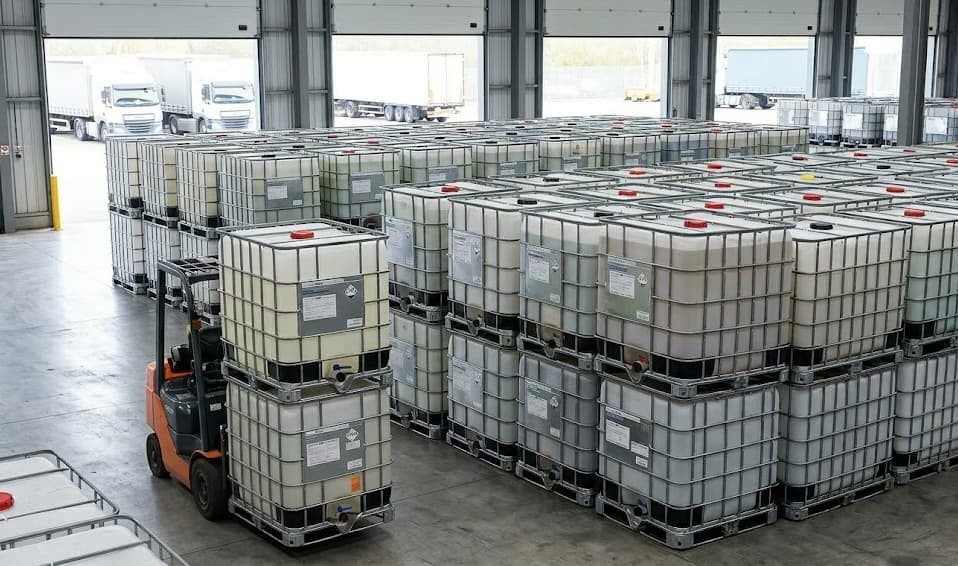
Today, IBC totes are so ubiquitous in industrial logistics that it's hard to imagine a time when they didn't exist. But the composite IBC tote as we know it — HDPE bottle in a galvanized steel cage on a pallet — is a relatively recent innovation that solved problems industrial businesses had struggled with for decades. Here's the story of how we got here.
Before IBCs: The Dark Ages of Bulk Liquid Shipping
For most of industrial history, bulk liquids were shipped in one of three ways: steel drums (55-gallon capacity), wooden barrels (varying sizes), or tank trucks/rail cars (thousands of gallons). Each had significant drawbacks.
Steel drums were heavy, expensive, prone to corrosion, difficult to empty completely, and took up enormous floor space relative to their capacity. A pallet of four 55-gallon drums held only 220 gallons in a footprint that could hold 275 gallons in a single IBC.
Wooden barrels worked for some products but were prone to leaking, absorbed product flavors and odors, were not chemically compatible with many substances, and required skilled coopers to build and repair.
Tank trucks and rail cars were efficient for very large volumes but impractical for shipments between 100 and 1,000 gallons, which is actually where the majority of industrial liquid commerce occurs.
The Gap in the Market
Through the 1960s and 1970s, industrial logistics professionals recognized a clear gap: there was no good packaging solution for quantities between a drum (55 gallons) and a tank truck (4,000+ gallons). This "intermediate" volume range — typically 100 to 350 gallons — required either multiple drums (expensive, space-inefficient) or partially-filled tank trucks (wasteful, costly per gallon).
Early IBC Designs (1970s-1980s)
The first intermediate bulk containers appeared in the 1970s, primarily in Europe. These early designs included rigid polyethylene tanks without external cage protection, collapsible fabric IBCs (flexitanks), stainless steel IBCs for chemical applications, and fiberglass reinforced plastic tanks.
Each had limitations. Rigid PE tanks without cages were vulnerable to damage and difficult to stack. Flexitanks couldn't maintain shape when partially filled. Stainless steel was prohibitively expensive. And fiberglass was heavy and couldn't be economically produced at scale.
The Composite IBC Innovation (1980s)
The breakthrough came when someone (historical credit is disputed between several European packaging companies) combined three elements into a single design: an inner container of blow-molded HDPE (cheap, light, chemically resistant), an outer cage of welded galvanized steel (structural protection, stackability), and a standard pallet base (forklift compatible, truck-loading efficient).
This composite design solved every problem at once. The plastic bottle provided light weight, corrosion resistance, and easy cleaning. The steel cage provided impact protection, stackability, and tie-down points. The pallet base made the container compatible with every standard forklift and rack system in existence.
Standardization and Global Adoption (1990s)
The 1990s saw rapid standardization. The UN Performance Packaging Code assigned IBC designation 31HA1 for composite IBCs with plastic inner containers and steel outer cages. The dominant capacity settled at 1,000 liters (264 gallons) in Europe and 275 US gallons in North America. Pallet dimensions standardized to 48 by 40 inches in North America and 1200 by 1000mm in Europe, matching existing pallet standards. The 2-inch (DN50) S60x6 thread became the universal valve connection.
This standardization was crucial for adoption. Once any manufacturer's IBC could work with any customer's filling equipment, handling systems, and transport infrastructure, switching costs dropped to zero and market adoption accelerated rapidly.
The Modern IBC Era (2000s-Present)
Since 2000, IBC technology has continued to evolve. Multi-layer HDPE bottles with barrier layers now prevent permeation of aggressive chemicals. Anti-static bottles prevent spark discharge when filling flammable liquids. RFID tracking chips molded into bottles enable supply chain visibility. Improved cage designs reduce weight while maintaining protection. And the recycling and reconditioning industry (like IBC Recycling Detroit) has made the economics of reuse even more compelling.
Why IBCs Won
The IBC tote dominates intermediate bulk liquid packaging today for a simple reason: it offers the best combination of cost, convenience, compatibility, and sustainability of any packaging format for its volume range. Compared to drums, a single IBC holds 5x more product in roughly the same floor space, reducing handling labor by 80%. Compared to tank trucks, IBCs offer granular quantity flexibility without minimum order requirements.
Looking Forward
The future of IBC packaging likely involves increased use of recycled and ocean-bound plastic in bottle manufacture, smart IBCs with integrated sensors for temperature, fill level, and GPS tracking, standardized return/refill logistics networks similar to pallet pooling, and regulatory drivers (like Extended Producer Responsibility) that incentivize reuse over disposal.
At IBC Recycling Detroit, we're proud to be part of this evolution — helping give every container the longest possible productive life before its materials begin their next chapter.