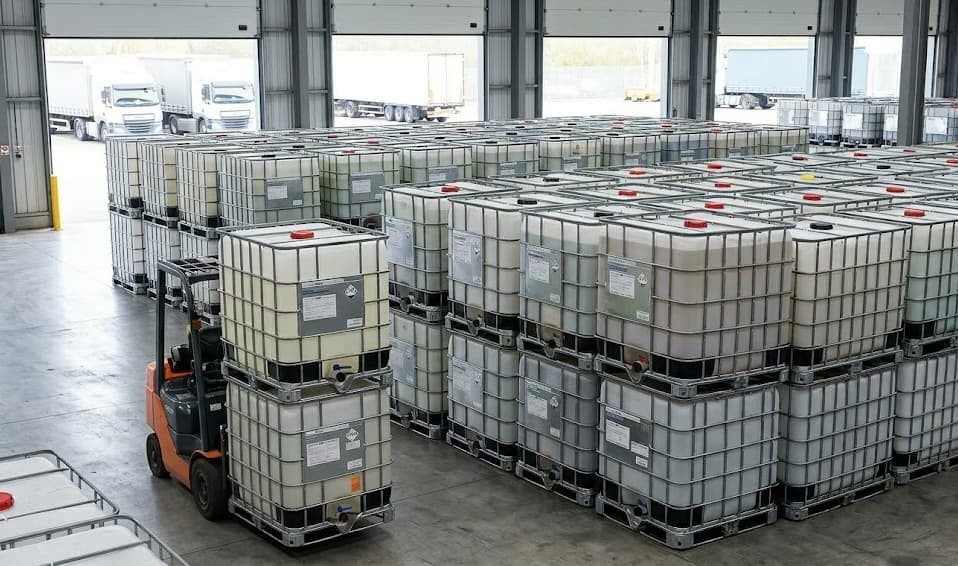
When an IBC tote has reached the end of its useful life as a container — too damaged for rebottling, too degraded for reconditioning — it enters our material recycling stream. But what actually happens to that 62 pounds of HDPE plastic? The answer involves a fascinating industrial process that transforms worn-out container plastic into valuable raw material for entirely new products.
Step 1: Disassembly
The first step is separating the IBC into its component materials. This is done manually at our facility because automated systems can't match human judgment in identifying contamination or damage that affects recyclability.
The steel cage is removed by cutting the securing bolts. The HDPE bottle is lifted from the pallet. The valve assembly is removed (these are cleaned and resold or recycled separately as metal). The pallet is inspected — if it's still serviceable, it's reused; otherwise it enters the wood or plastic recycling stream.
At this stage, each material goes to its appropriate recycling pathway. We're focusing on the HDPE bottle here because it represents the highest-volume and highest-value recyclable component.
Step 2: Inspection and Sorting
Not all HDPE bottles are equal in the recycling stream. They're sorted by color because natural/white HDPE has significantly higher recycling value than blue or black. Mixing colors produces less desirable output. They're also sorted by contamination level — bottles that held food products or clean chemicals process more easily than those with stubborn residues like adhesives, paints, or certain agricultural chemicals.
Bottles with severe UV degradation, chemical staining that can't be removed, or physical contamination (labels, stickers, incompatible plastic attachments) are flagged for additional processing or energy recovery rather than mechanical recycling.
Step 3: Shredding
Sorted bottles are fed into an industrial granulator — essentially a massive set of rotating blades that reduces the HDPE into flakes approximately 10-15mm in size. This is a loud, energy-intensive process, but the resulting flakes have enormously more surface area than the original bottle, which is essential for the cleaning steps that follow.
The shredder also serves as a secondary quality control point. Metal fragments (from cage remnants or valve parts) are caught by magnetic separators. Heavier contaminants fall to the bottom of screening systems. And severely degraded plastic often shatters into powder rather than clean flakes, allowing it to be separated by air classification.
Step 4: Washing and Decontamination
The shredded flakes go through a multi-stage washing process. First, a cold water float/sink tank separates HDPE (which floats) from denser contaminants like PET labels, metal fragments, rubber gaskets, or dirt (which sink). Then a hot caustic wash at 180F with sodium hydroxide solution removes residual product traces, adhesive residues, oils, and organic contamination. Finally, a friction washer uses mechanical agitation combined with clean water to remove the last traces of contamination and achieve food-contact-grade cleanliness if the output will be used for those applications.
After washing, the flakes are centrifugally dried to less than 1% moisture content. Any remaining moisture causes problems in the next step.
Step 5: Pelletization (Extrusion)
This is where the magic happens. Clean, dry HDPE flakes are fed into an extruder — a heated barrel containing a large rotating screw. The heat (typically 350-400F for HDPE) and mechanical pressure melt the plastic flakes into a homogeneous molten mass. The molten HDPE is forced through a die plate containing dozens of small circular holes, emerging as thin strands that are immediately cooled in a water bath and chopped into uniform cylindrical pellets by a rotating blade.
These pellets — called regrind, rPE, or post-consumer recycled HDPE — are the finished recyclable commodity. They look like small translucent cylinders about 3mm in diameter and can be used in plasticprocessing equipment just like virgin HDPE pellets.
Step 6: Quality Testing
Before being sold to manufacturers, recycled HDPE pellets undergo rigorous quality testing. Melt flow index (MFI) testing confirms the material flows properly during molding or extrusion. Density testing verifies material purity with no mixed plastics. Color measurement ensures consistency across batches. Mechanical testing confirms tensile strength, impact resistance, and elongation at break meet specifications. And contamination testing checks for heavy metals, residual chemicals, or biological contamination.
Pellets that pass all tests are bagged (usually in 55-lb bags or 2,000-lb supersacks) and sold to manufacturers.
What Gets Made from Recycled IBC HDPE?
The recycled pellets from IBC totes become raw material for a huge variety of products. Drainage pipe and corrugated culvert which is the single largest end market for recycled HDPE. Plastic lumber and composite decking used for park benches, playground structures, boardwalks, and agricultural fencing. Automotive parts including under-body panels, wheel well liners, and cargo area liners in trucks. New pallets and material handling products. Recycling bins, trash cans, and carts. Agricultural irrigation pipe and fittings. Geomembrane liners for ponds, landfills, and containment systems.
The Environmental Math
Recycling one IBC tote bottle instead of sending it to landfill saves 2.5 barrels of crude oil that would be needed to produce virgin HDPE, prevents 120 kg of CO2 emissions from virgin resin production, conserves approximately 2,000 gallons of water used in virgin manufacturing, and keeps 62 lbs of plastic out of landfills where it would persist for 450+ years.
Multiply that by the thousands of IBC bottles we process annually, and the cumulative environmental benefit is substantial. This is the power of proper recycling — not just avoiding waste, but actively reducing demand for virgin resource extraction.