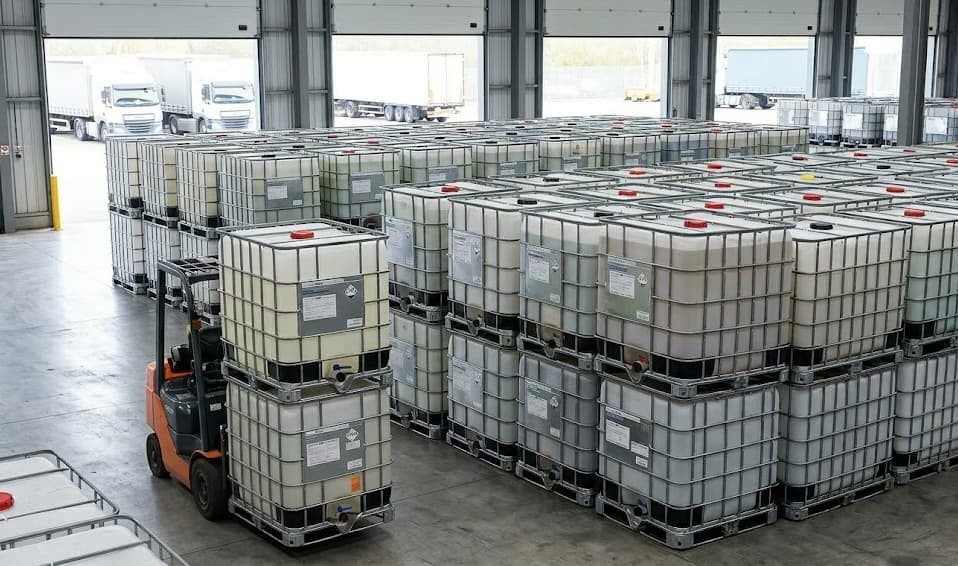
One of the most common questions we hear at IBC Recycling Detroit is whether a customer needs a food-grade or industrial-grade IBC tote. The answer matters — both for regulatory compliance and for your budget. Getting it wrong in either direction can be costly. Here's a comprehensive guide to making the right choice.
What Makes an IBC "Food-Grade"?
A food-grade IBC tote is manufactured from HDPE resin that meets FDA 21 CFR 177.1520 requirements for direct food contact. This means the resin contains no additives or plasticizers that could leach into food products, the manufacturing process uses only FDA-approved mold release agents, the container passes migration testing ensuring nothing transfers from plastic to contents, and the facility meets food-safe manufacturing standards with full GMP compliance.
The physical construction of a food-grade IBC is identical to an industrial one — same cage, same valve, same pallet, same dimensions. The difference is entirely in the resin formulation and manufacturing controls. You cannot visually distinguish a food-grade tote from an industrial one without checking documentation.
When You MUST Use Food-Grade
Food-grade IBCs are legally required when storing or transporting any substance intended for human consumption such as beverages, oils, syrups, or honey. They're also required for ingredients that will be incorporated into food products, potable water for drinking or food preparation, pharmaceutical ingredients or intermediates, food-contact cleaning agents like CIP solutions used in food plants, and cosmetic ingredients that contact skin.
The key test is whether the substance in the IBC will eventually be consumed, applied to skin, or come into contact with food at any point in the supply chain. If the answer is yes at any stage, food-grade is required.
When Industrial Grade Is Perfectly Fine
Many customers overspend on food-grade totes when industrial grade would be entirely appropriate and save them significant money. Industrial-grade IBCs are suitable for soaps and detergents even those for kitchen use since the IBC doesn't contact the end product, automotive fluids including coolants, washer fluid, and lubricants, agricultural chemicals and fertilizers, paints, coatings, and adhesives, industrial cleaners and degreasers, non-potable water for cooling, irrigation, or dust suppression, and waste collection and holding.
The Cost Difference
New food-grade IBCs typically cost 15-25% more than industrial grade from the same manufacturer. In the used and reconditioned market, the premium is even higher because food-grade totes must have verified previous contents and a documented chain of custody.
For a new 275-gallon container, food-grade runs $350-$450 while industrial is $275-$350. For used Grade A containers, food-grade is $175-$250 while industrial is $120-$180. That's a significant difference when you're buying dozens or hundreds of containers annually.
The Contamination Trap
Here's a critical point many buyers miss: once a food-grade IBC has been used for non-food chemicals, it can never be re-certified as food-grade. HDPE is a semi-porous material at the molecular level. Even thorough cleaning cannot guarantee that all traces of industrial chemicals have been removed from the plastic matrix. The molecules physically embed themselves in the polymer chains.
This means you should never use food-grade IBCs for non-food products if you want to resell them later at food-grade prices. Always verify the complete use history of any "food-grade" tote you purchase used. Be wary of sellers who claim food-grade status without documentation.
How to Verify Food-Grade Status
When purchasing used food-grade IBCs, look for manufacturer documentation where the original manufacturer can confirm the resin grade, previous contents verification where reliable sellers document what was previously stored, visual inspection since food-grade totes that held food products typically show minimal discoloration, FDA compliance statements that some manufacturers stamp or label on the bottle, and certificates of cleaning with professional reconditioning using food-safe procedures.
At IBC Recycling Detroit, every food-grade tote we sell comes with a written statement of previous contents and a certificate confirming food-safe cleaning procedures. We never label an industrial tote as food-grade, regardless of how clean it appears. Our reputation depends on honest grading.
Our Recommendation
If your application does not legally require food-grade certification, save money with industrial-grade totes. The plastic quality and structural integrity are identical — the only difference is the regulatory documentation and resin certification. Put those savings toward buying more containers or upgrading to Grade A condition for better longevity.
Not sure which you need? Contact us with details about your application and we'll give you honest guidance — even if it means recommending the less expensive option.