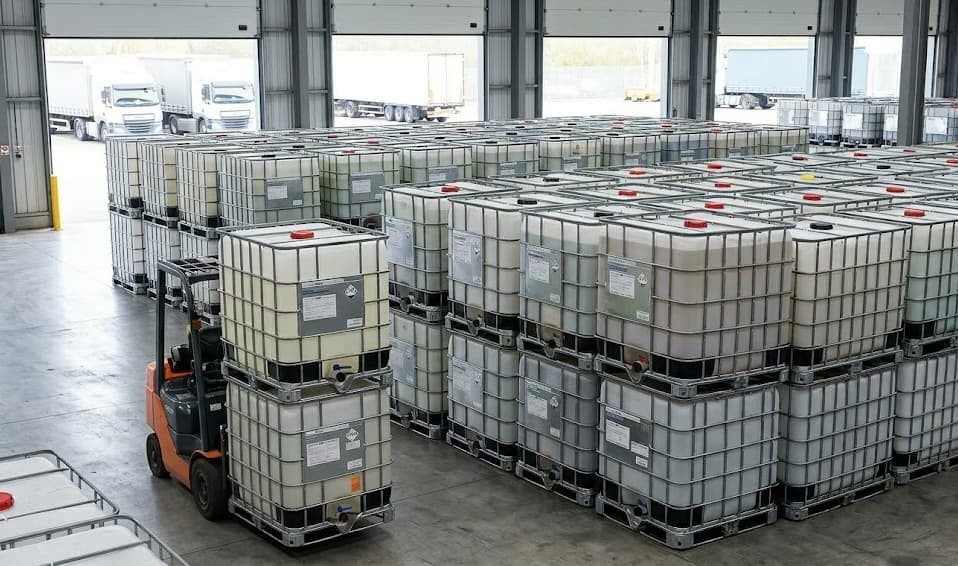
Choosing between IBC totes, 55-gallon drums, and tank storage isn't as simple as picking the right volume. Each option has distinct advantages in specific scenarios, and the wrong choice can cost your business significantly in wasted space, excess handling labor, or unnecessary capital expenditure. This comparison will help you match the right storage format to your needs.
The Three Contenders
Before diving into comparison, let's define our options:
55-gallon drums are the classic industrial liquid container. Steel or HDPE construction, relatively inexpensive individually, universally available, and compatible with enormous existing infrastructure (drum racks, pumps, handlers, etc.). Capacity: 55 gallons per unit.
IBC totes are the intermediate option — 275 or 330 gallons in a single handled unit. Composite construction (HDPE bottle in steel cage on pallet). Reusable, recyclable, forklift-compatible.
Fixed or portable tanks include everything from 500-gallon poly tanks to 10,000+ gallon steel or fiberglass installations. Can be permanent or semi-permanent. Usually require pumps for dispensing.
Comparison Factor 1: Cost Per Gallon Stored
This is usually the first question, and the answer depends on volume:
For drums at $25-$40 new ($8-$15 used/reconditioned), the cost per gallon of storage is $0.45-$0.73 new or $0.15-$0.27 reconditioned.
For IBC totes at $290-$450 new ($120-$225 reconditioned), the cost per gallon of storage is $1.05-$1.64 new or $0.44-$0.82 reconditioned.
Wait — drums are cheaper per gallon? Yes, on purchase price alone. But that ignores handling cost, which is where IBCs win dramatically (see Factor 3).
For permanent tanks, the economics change entirely. A 5,000-gallon poly tank installed costs $8,000-$15,000 (including pad, containment, piping), which is $1.60-$3.00 per gallon of capacity. But it lasts 20+ years with minimal maintenance. At scale, permanent tanks offer the lowest annual cost per gallon.
Comparison Factor 2: Space Efficiency
This is where IBCs dominate in warehouse environments:
4 drums on a pallet: 48 by 40 inch footprint, holds 220 gallons. Storage density = 0.52 gallons per square inch of floor space.
1 IBC tote on same footprint: 48 by 40 inches, holds 275 gallons. Storage density = 0.65 gallons per square inch of floor space.
That's 25% more product in the same floor space. For warehouses where space costs $8-$15 per square foot annually, this density advantage translates directly to reduced storage costs.
Drums can be stacked higher (3-4 pallets high versus 2 high for IBCs), partially offsetting the per-level difference. But this requires drum racks, better forklifts, and introduces safety concerns.
Comparison Factor 3: Handling Labor
This is the hidden cost that usually makes the decision. Consider filling a 2,000-gallon order:
With drums: 37 drums must each be positioned, filled (including time for pump connections and air displacement), sealed, labeled, palletized (4 per pallet on 9 pallets), and staged for shipping. At approximately 5 minutes per drum, that's 3 hours of labor.
With IBCs: 8 totes must each be positioned, filled, sealed, and staged. At approximately 8 minutes per tote, that's about 1 hour of labor.
The same product volume, but IBCs reduce handling labor by 67%. At a loaded labor rate of $35/hour, that's $70 saved per 2,000-gallon order. Over hundreds of orders annually, the labor savings dwarf any per-gallon purchase price difference.
Comparison Factor 4: Shipping Efficiency
On a standard 53-foot trailer with a 44,000-lb payload limit shipping water-weight product:
Drums: 80 drums per trailer (20 pallets of 4) = 4,400 gallons per truck.
IBCs: 18 IBCs per trailer (weight-limited) = 4,950 gallons per truck.
IBCs ship 12.5% more product per truck, reducing per-gallon freight cost proportionally.
Comparison Factor 5: Dispensing and Metering
Drums excel for small, precise quantities. A drum pump can dispense exact amounts, and individual drums can be dedicated to specific products or customers without cross-contamination concerns.
IBCs are better for high-volume dispensing (filling tanks, feeding production lines, bulk transfers). The 2-inch bottom valve provides excellent flow rates and the capacity means fewer container changes during long production runs.
Tanks are ideal for continuous-flow operations where product is metered out steadily over days or weeks via permanent piping and automated dispensing systems.
Decision Framework
Choose drums when quantities per SKU are under 200 gallons, you need precise dispensing of multiple different products, your customers order in small quantities (5-50 gallons), or existing infrastructure (racks, pumps, handlers) is drum-specific.
Choose IBC totes when quantities per SKU are 200-2,000 gallons, you ship or receive in intermediate volumes, handling labor cost is a concern, warehouse floor space is expensive, or you value reuse and recycling (environmental consideration).
Choose permanent tanks when you use more than 5,000 gallons of a single product regularly, continuous-feed operations require constant supply, products arrive by tanker truck, or you have long-term facility commitments (5+ years at same location).
The Hybrid Approach
Many businesses use all three formats for different products or purposes. Tanks for high-volume primary materials. IBCs for intermediate products, incoming raw materials, and outbound shipping. And drums for specialty chemicals, samples, and small-quantity inventory.
There's no one-size-fits-all answer — but for the intermediate range that IBCs serve (200-2,000 gallons per SKU), they consistently offer the best balance of cost, space efficiency, and handling labor. And with reconditioned options from IBC Recycling Detroit, the upfront cost barrier is minimal.