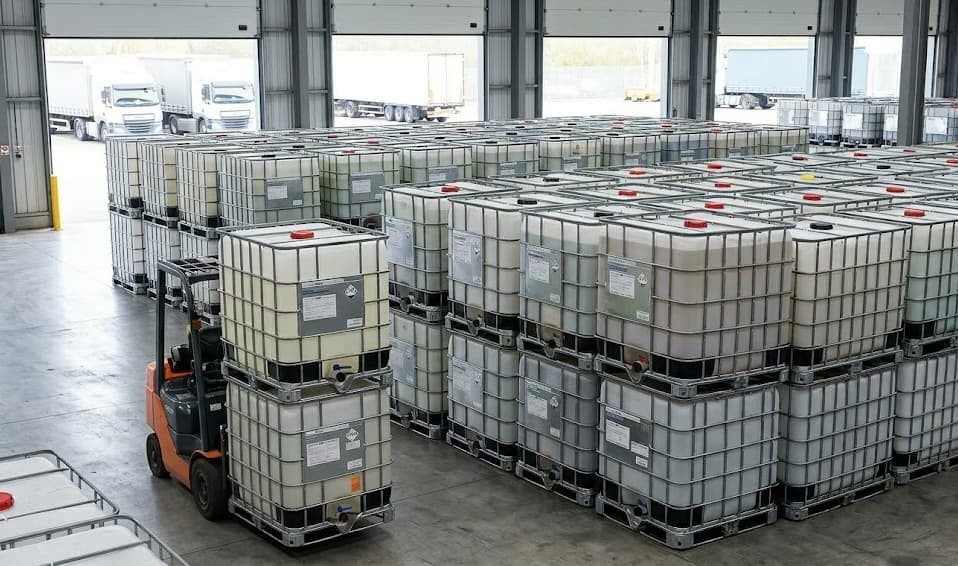
In our years of processing thousands of IBC totes, we've seen every possible failure mode. Most are entirely preventable with basic awareness and maintenance. Here are the seven most common ways IBC totes fail, what causes each one, how to spot early warning signs, and what to do to prevent them.
Failure 1: Bottom Valve Leak
This is by far the most common IBC failure we encounter. The bottom valve develops a slow leak — sometimes just a drip, sometimes a steady stream — that goes unnoticed until a significant amount of product has been lost or a puddle forms under the tote.
Root causes include gasket degradation from chemical exposure, temperature cycling, or simple age. Over-tightening the valve onto the bottle outlet which deforms the gasket. Cross-threading during valve installation which prevents proper seating. And chemical attack on the valve body, particularly with strong solvents or oxidizers.
Warning signs: any moisture or staining around the valve connection, difficulty turning the valve handle smoothly, visible gasket material extruding from the joint, and drips that appear only when the tote is full (hydrostatic pressure).
Prevention: replace gaskets proactively every 12 months or every 3 fill cycles (whichever comes first). Never over-torque — hand-tight plus a quarter turn is sufficient. Use chemically compatible gasket materials (Viton for solvents, EPDM for water-based products, PTFE for aggressive chemicals). Inspect before every fill.
Failure 2: Bottle Stress Cracking
HDPE is susceptible to environmental stress cracking (ESC) — a phenomenon where the combination of mechanical stress and chemical exposure causes cracks to propagate slowly through the plastic. This is insidious because the crack may not leak initially but then fails catastrophically under load.
Root causes include long-term storage of products that are stress-crack agents (surfactants, some solvents, hot oils), UV exposure degrading the polymer's resistance to cracking, overfilling which creates internal pressure on already-stressed corners, and using a tote beyond its intended service life.
Warning signs: fine white lines (crazing) on the bottle surface, small cracks around high-stress areas (corners, near the valve, around the top opening), stress whitening where the plastic appears lighter or cloudy, and reduced flexibility when the plastic feels more brittle than expected.
Prevention: don't store known stress-crack agents longer than the manufacturer recommends, protect from UV exposure during storage, never exceed rated capacity, and retire totes that show any stress whitening or crazing.
Failure 3: Cage Weld Failure
The steel cage's welded joints can fail due to corrosion, fatigue, or impact damage. A broken cage weld compromises the structural protection of the bottle and can lead to cage collapse during stacking or transport.
Root causes include corrosion at weld points where galvanizing was burned away during manufacturing, fatigue from repeated stacking and destacking cycles, impact damage from forklift collisions, and operating in highly corrosive environments like salt spray or chemical vapors.
Warning signs: rust staining at weld joints, visible gaps or cracks at connection points, cage sections that flex or move when pushed, and misalignment between cage and bottle.
Prevention: store in dry conditions when possible, inspect welds during every cleaning cycle, repair or replace damaged cage sections promptly, and don't stack higher than the manufacturer's rating.
Failure 4: Pallet Failure Under Load
A weakened or damaged pallet can split or collapse when carrying a full IBC (up to 2,900 lbs). This typically results in the entire unit tipping and potentially rupturing the bottle.
Root causes include moisture damage to wood pallets from ground contact or outdoor storage, impact damage from forklift entry at wrong angle, overloading by stacking too many totes on top, and natural degradation of wood fibers over time.
Warning signs: split or cracked pallet boards, soft or spongy areas in wood, visible mold or rot, warping or cupping of deck boards, and rattling or movement when lifting.
Prevention: never store wood-palletized IBCs directly on bare ground, inspect pallets before every filling, replace damaged pallets immediately rather than continuing to use them, and consider upgrading to steel or plastic pallets for long-term or outdoor use.
Failure 5: UV Degradation
Ultraviolet radiation from sunlight breaks down HDPE polymer chains over time, making the bottle progressively more brittle. This is a slow-motion failure that's easy to ignore until the bottle suddenly cracks.
Root causes include extended outdoor storage without UV protection, storage in facilities with skylight or large window exposure, and using clear or natural-colored bottles (which have less UV protection than blue or black).
Warning signs: yellowing or chalky appearance of the plastic, surface becoming rough or powdery to the touch, increased brittleness where the plastic snaps rather than flexing, and fading of printed labels or markings.
Prevention: store indoors whenever possible, use UV-protective covers or tarps for outdoor storage, limit outdoor exposure to less than 12 months cumulative, prioritize blue or black bottles for outdoor applications, and retire bottles showing any yellowing or surface degradation.
Failure 6: Overpressure Event
IBCs are not pressure vessels. They're designed for atmospheric pressure storage. Yet overpressure events are surprisingly common and can range from a bulged bottle to catastrophic rupture.
Root causes include thermal expansion where a completely full tote is moved from cold storage to hot sun, chemical reactions in the container generating gas such as fermentation of organic materials, filling with a pump that doesn't have pressure relief which can momentarily overpressure the system, and blocked vent where the top cap is sealed while product is being pumped out (creates negative pressure then positive when released).
Warning signs: bulging or swelling of the bottle, cap or valve pushed outward, hissing sounds from the cap area, and bottle that feels pressurized when pushed.
Prevention: never fill above the maximum fill line (typically 90-95% capacity), leave headspace for thermal expansion, use vented caps when chemical reactions are possible, ensure pump systems have appropriate relief valves, and never seal a tote that contains a product capable of off-gassing.
Failure 7: Forklift Puncture
This is the most preventable failure on the list — and one of the most costly. A forklift tine driven through the HDPE bottle results in immediate catastrophic product loss, potential environmental contamination, and the tote being rendered completely unrepairable.
Root causes include inexperienced forklift operators approaching at wrong angle, poor visibility around stacked IBCs, rushing during loading and unloading operations, and worn or bent fork tines that don't enter pallet openings cleanly.
Warning signs: near-misses (tines contacting bottle without penetration), scuff marks on bottles from tine contact, and damaged cage sections at fork-entry height.
Prevention: train all forklift operators specifically on IBC handling procedures, install fork tip guards or protective plates on frequently-handled totes, maintain adequate lighting in IBC storage areas, never rush pallet entry, and report all near-misses so procedures can be improved.
The Cost of Prevention vs Failure
Implementing all the preventive measures described above costs perhaps $10-$20 per tote per year in inspection time, replacement gaskets, and protective accessories. A single failure event — between product loss, cleanup, environmental liability, and replacement — typically costs $500-$5,000 or more. The math strongly favors prevention every time.