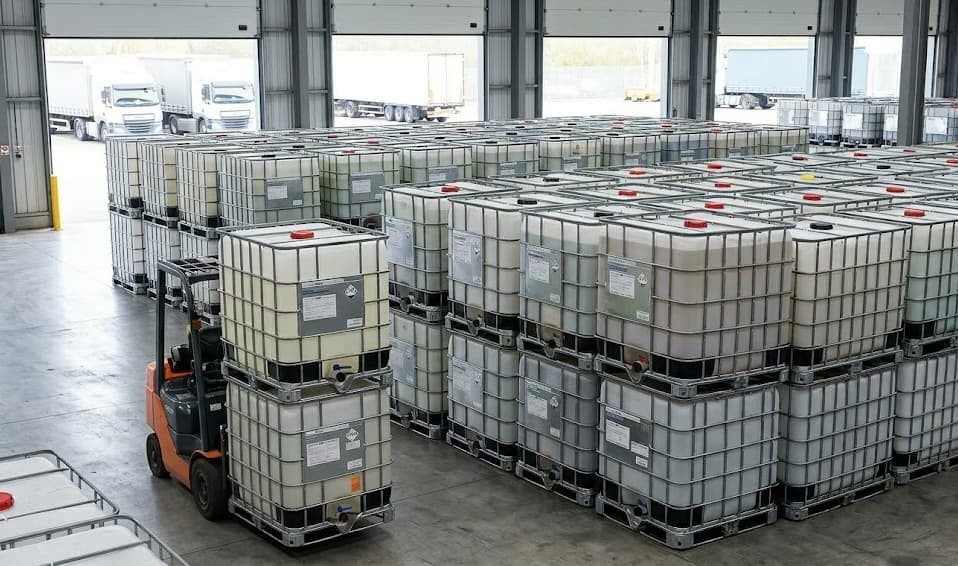
Choosing the right IBC tote size might seem straightforward — just pick the one that holds enough of your product, right? In practice, the decision involves a complex interplay of factors including available floor space, forklift capacity, truck payload limits, product viscosity, filling equipment compatibility, and total cost of ownership. This guide walks you through the decision for each common IBC size.
The Standard Sizes
IBC totes are manufactured in four primary capacities:
The 275-gallon (1,040 liters) is by far the most common size in North America, accounting for approximately 80% of all IBCs in circulation. External dimensions are 48 inches long by 40 inches wide by 46 inches tall. Empty weight is approximately 130-145 lbs. Full weight with water is approximately 2,425 lbs. The standard pallet footprint fits all standard forklifts and rack systems.
The 330-gallon (1,250 liters) is the second most popular size, offering 20% more capacity in the same footprint by increasing height to approximately 53 inches. Empty weight is approximately 145-160 lbs. Full weight with water is approximately 2,900 lbs. Same 48 by 40 inch pallet footprint as the 275.
The 180-gallon (680 liters) is less common but useful for operations with space or weight constraints. External dimensions are 43 inches long by 37 inches wide by 40 inches tall. Empty weight is approximately 95-110 lbs. Full weight with water is approximately 1,600 lbs.
The 110-gallon (416 liters) is the smallest standard IBC, sometimes called a mini-IBC or half-tote. External dimensions are 40 inches long by 32 inches wide by 38 inches tall. Empty weight is approximately 65-80 lbs. Full weight with water is approximately 985 lbs.
Decision Factor 1: Product Volume
The most basic calculation is how much product you need to store or ship. But don't just match volume to container size — consider batch sizes (does your process produce exactly 275 gallons at a time?), minimum order quantities from your suppliers, headspace requirements for products that expand with temperature, and whether partial fills are acceptable for shipping (less-than-full IBCs can shift during transport).
Decision Factor 2: Facility Constraints
Measure your doorways, aisle widths, ceiling heights, and rack dimensions before ordering. The 330-gallon tote is 7 inches taller than the 275 — that extra height can be the difference between fitting under a mezzanine or not, or between two-high stacking being possible in your warehouse. Also consider floor load capacity: a full 330-gallon IBC weighs nearly 1.5 tons in a 40-by-48-inch footprint.
Decision Factor 3: Shipping Economics
Standard 53-foot trailers can accommodate 20 IBCs (275 or 330 gallon) per load when floor-loaded single-stack. If you can stack two-high, you get 40 per trailer. The 330-gallon size gives you 20% more product per container at the same number of containers per truck — that's 20% fewer deliveries, 20% less fuel, and significantly reduced freight cost per gallon.
However, full 330-gallon IBCs at 2,900 lbs each will exceed truck weight limits before the trailer is volumetrically full if you're shipping heavy liquids. Do the math: 20 full 330-gallon IBCs weigh 58,000 lbs, well over the typical 44,000-lb payload limit. You may only be able to load 15 per truck.
Decision Factor 4: Handling Equipment
Your forklift must be rated for the full weight of the largest IBC you plan to use. A full 330-gallon IBC at 2,900 lbs requires a forklift rated for at least 4,000 lbs (accounting for load center offset). A full 275-gallon at 2,425 lbs can be handled by most standard 3,000-lb capacity forklifts.
Also consider your filling equipment. Pump flow rates, filling nozzle positions, and tank outlet heights may be optimized for a specific IBC height. Switching sizes could require repositioning equipment.
Decision Factor 5: Total Cost of Ownership
The purchase price difference between sizes is relatively small — usually 10-15% between a 275 and 330 gallon of the same grade. But total cost of ownership includes purchase price, shipping cost per gallon of product, storage cost per gallon (floor space), handling time and labor, cleaning and maintenance, and residual value when selling used containers.
For most applications shipping full truckloads, the 330-gallon tote offers the lowest total cost per gallon shipped. For operations limited by weight rather than volume, or facilities with height constraints, the 275-gallon is optimal. The 110 and 180 gallon sizes serve niche applications where standard sizes are simply too large to handle practically.
Our Recommendation
If you're unsure, start with the 275-gallon. It's the industry standard for a reason — maximum compatibility with existing infrastructure, the largest selection of used/reconditioned options, and the easiest to resell when you're done with it. The 275's ubiquity also means replacement parts, accessories, and service options are most readily available and affordable.
Contact us with your specific requirements and we'll help you determine the ideal size for your operation.